Do You Pay Taxes on an Inherited House? The Iowa Answer
Inheriting a house in Iowa is not a taxable event. Iowa's inheritance tax is gone and federal estate tax will not reach you. What actually costs money is the property tax, the homestead credit that falls off the year after the death, and gain if you hold on.
Selling an Inherited House in Iowa: Probate, Taxes and Your Options
Inheriting a house in Iowa is not a taxable event. You do not report it as income, you do not owe a tax for receiving it, and in almost every case nothing is due on the day the deed changes hands.
The taxes arrive later, and from directions most people are not watching. Iowa's inheritance tax is gone. Federal estate tax will not touch you. What will actually cost you money is the property tax bill that keeps arriving, a homestead credit that quietly falls off the house the year after the death, and capital gains if you hold the place while it appreciates.
This page goes through each one in the order you will meet it, with the Iowa numbers rather than the generic national ones.
The short answer, tax by tax
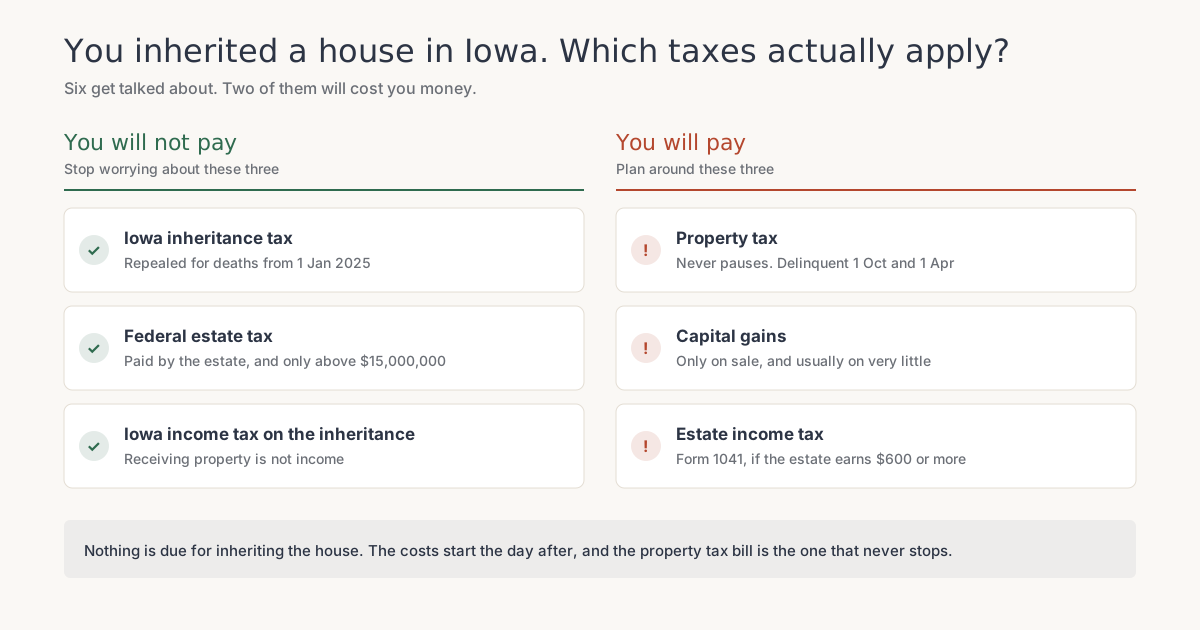
| Tax | Do you owe it? |
|---|---|
| Iowa inheritance tax | No. Repealed for deaths on or after 1 January 2025 |
| Federal estate tax | Almost certainly not. The estate pays, and only above $15,000,000 |
| Iowa income tax on the inheritance | No. Receiving property is not income |
| Property tax | Yes. It never stops, and it usually goes up |
| Capital gains | Only when you sell, and usually on very little |
| Federal estate income tax | Sometimes, if the estate itself earns $600 or more |
Two of those six will apply to you. The rest are noise you can stop worrying about.
Iowa's inheritance tax no longer exists
Iowa spent decades as one of a handful of states charging heirs a tax based on how closely related they were to the person who died. That is over.
Under Iowa Code section 450.98, the inheritance tax chapter does not apply to the estates of people dying on or after 1 January 2025, and to that extent the chapter is repealed. It was phased down over four years before that, and the phase-down finished.
If the death was in 2024 or earlier, the old rules still govern that estate. If it was 2025 or later, there is nothing to file and nothing to pay.
You will still find current-looking articles listing Iowa among the inheritance tax states. Some of them were updated this year and are still wrong. The statute above is the answer.
Federal estate tax is somebody else's problem
Two things about estate tax that get confused constantly.
First, it is paid by the estate, before anything is distributed. It is not a bill that arrives for you personally.
Second, the threshold is enormous. The basic exclusion amount is $15,000,000 for a death in calendar year 2026, doubled for a married couple where the first spouse's unused exclusion is carried over. The IRS confirmed that figure in Revenue Procedure 2025-32, which sets it out at section 3.14.
The median Polk County house is not within two orders of magnitude of that. Iowa also has no separate state estate tax. Unless the estate holds a working farm operation, a business, or serious investment assets, this line is a no.
Property tax: the one that actually shows up
Here is the bill nobody warns heirs about, and it starts running the day of the death.
Iowa property tax is paid in two instalments in arrears, and under section 445.37 the first becomes delinquent on 1 October and the second on 1 April. Nobody sends the estate a courtesy pause. If probate is running and the house is sitting empty, those instalments keep coming due, and interest starts the day after delinquency.
The homestead credit falls off, and this is the part that stings
Your parent almost certainly had the homestead credit on that house. It reduces the taxable value by the levy on the first $4,850 of actual value under section 425.1.
That credit is attached to a person who lives there, not to the house. Section 425.11 defines an owner who can claim it as including a person occupying the homestead under devise or by operation of the inheritance laws. Occupying. If you inherit the house and do not move in, you do not qualify.
Worse, the credit does not simply lapse quietly. Section 425.2 requires the personal representative of a deceased person who had a homestead at the time of death to give written notice to the assessor that the property is no longer that person's homestead. It also requires a new owner who wants the credit to refile, by 1 July of the year they are claiming it. Miss that date and the claim counts for the following year instead.
So there are two distinct jobs here:
- Somebody has to tell the assessor the old claimant has died. That is a statutory duty on the personal representative, not an optional courtesy.
- If you are moving in, you have to file your own claim by 1 July.
If the house is empty and being prepared for sale, neither of those helps you. The credit is gone and the bill is a little higher for the duration.
Owing back tax does not stop a sale
If instalments went unpaid before the death, they follow the property. They come out of the closing rather than blocking it, so delinquent tax is a deduction from your proceeds, not a wall. Polk County publishes the current balance for any parcel, and it is worth knowing the number before you plan around a sale price.
Capital gains, and why yours is probably tiny
This is the tax people expect to be brutal and it is usually close to nothing, because of one rule.
When you inherit property, your cost basis is not what the deceased paid. IRS Publication 551 sets the basis of property acquired from a decedent at the fair market value at the date of death, or at the alternate valuation date if the estate elects it. Every year of appreciation before the death simply disappears from the calculation.
Your mother bought the house in Beaverdale in 1994 for $71,000. She died in February, when it was worth $248,000. You sell in July for $255,000, paying $16,000 in commission and closing costs.
Your basis is $248,000, not $71,000. Your gain is $255,000 minus $16,000 minus $248,000, so a loss of $9,000.
Without the step up, the gain would have been $168,000.
That is the normal shape of it. Sell within a year or so of the death and the gain is small, nil, or negative. Hold the house for six years while Des Moines values climb and you will owe on the growth since the death, which is the real cost of leaving a decision alone.
Inherited property is always treated as long-term whatever the holding period, so it gets long-term rates rather than ordinary income rates.
The federal rate, with the 2026 numbers
Long-term rates are 0%, 15% or 20%, and which one applies depends on your total taxable income, not just the gain. For tax years beginning in 2026, Revenue Procedure 2025-32 sets the maximum zero rate amounts at section 3.03:
| Filing status | 0% up to | 15% up to | 20% above |
|---|---|---|---|
| Single | $49,450 | $545,500 | $545,500 |
| Married filing jointly | $98,900 | $613,700 | $613,700 |
| Head of household | $66,200 | $579,600 | $579,600 |
| Estates and trusts | $3,300 | $16,250 | $16,250 |
Look at the last row. An estate hits the top rate at $16,250, where an individual would still be at zero. If the estate sells the house and holds the gain rather than distributing it, the tax treatment can be materially worse than if the heirs sold it themselves. That is a conversation to have with the estate's accountant before the sale, not after.
Iowa taxes the gain too, at a flat rate
Iowa has no separate capital gains rate. Under section 422.5, tax is imposed on your entire taxable income at a rate of three and eight-tenths percent, so a gain flows through at 3.8% like any other income.
If a later sale did leave you with a $12,000 gain, Iowa's share is $456 on top of the federal figure. It is not the headline number, but budget for it rather than being surprised.
What changes if you move in, or rent it out
Two forks, and they behave very differently.
If you move in and later sell, you may be able to exclude gain under the main home rules. IRS Topic 701 allows up to $250,000 of gain excluded, or $500,000 on a joint return, provided you owned and used the home as your main residence for at least 24 months of the 5 years ending on the sale date. Note the sequence: you inherit at stepped-up basis, then the clock starts. For most heirs the step up has already wiped out the gain, so the exclusion is belt and braces rather than the main event.
If you rent it out, the house becomes business property. The rent is taxable income, and you depreciate the building over 27.5 years under the general depreciation system, per IRS Publication 527. Depreciation is not optional in practice: when you eventually sell, the gain is calculated as though you had claimed it, whether you did or not. Renting an inherited house is a decision with a decade-long tax tail, and it is the option people drift into rather than choose. It also changes how you sell later, because a lease goes with the house.
The paperwork nobody mentions
Three filings, briefly.
Form 1041 is the estate's own income tax return. Per the IRS instructions for Form 1041, a domestic estate must file if it has gross income of $600 or more for the tax year. An estate that sells a house mid-administration usually clears that on the sale alone.
Form 1099-S reports the sale proceeds to the IRS, and the title company normally issues it at closing. The IRS receives a copy. If the sale is not on your return, expect a letter, even where your actual gain was nil.
Schedule D and Form 8949 are where you report the sale on your personal return if the house was distributed to you before the sale. Report it even at a loss. A stepped-up basis producing a small loss is a perfectly ordinary return; an unreported $255,000 of proceeds is a query.
What this means if the house is sitting empty in Des Moines
Put the tax picture together and the pattern is clear enough.
Nothing is due for inheriting. The gain on a prompt sale is close to zero. The costs that accumulate are property tax without the homestead credit, insurance at vacancy rates, utilities kept on so the pipes do not freeze, and the slow deterioration of a house nobody is in. Those are certain, monthly, and they do not care what the estate is worth.
If the house is in good shape and you have the patience, list it. You will net more, and our page on what your house is worth is a reasonable place to get a first number. There is a longer guide to selling an inherited house in Iowa covering the sale itself, siblings, and mortgages.
If it needs work you cannot fund from an estate with no cash in it, or three siblings need to agree, or you live four states away, a cash sale is the other option. It nets less. We will say that plainly, and anyone offering you market value in cash is not being straight with you. What it buys is a date certain, no repairs and no showings. How that works takes about a minute to read.
Whichever route you take, the tax outcome is identical. The IRS does not care who the buyer was.
Common questions
Do I pay income tax on money I inherit? No. Receiving an inheritance is not income under federal or Iowa law. If you then sell an asset for more than its stepped-up basis, that gain is taxable, but the inheritance itself is not.
Do I have to pay tax if I sell the house right away? Almost never anything meaningful. Your basis is the date-of-death value, so a sale soon after the death produces a very small gain or a loss once selling costs come off.
Does Iowa still have an inheritance tax? Not for deaths on or after 1 January 2025. For an earlier death, the old rules still apply to that estate.
Who pays the property tax while probate is running? The estate does, out of estate funds, and it is an administration expense. The instalments stay on the same schedule and become delinquent on 1 October and 1 April regardless of the death.
Do I lose the homestead credit? If you do not live in the house, yes. The credit needs an owner occupying the property, and a new occupying owner has to refile with the assessor by 1 July.
What if there are several heirs? Each of you takes a stepped-up basis in your share, and each reports your own portion of any gain. Selling and dividing the proceeds is cleaner than one heir buying the others out, which raises its own valuation questions.
Do I need an appraisal? Get one if there is any chance of a dispute or a later query. The entire calculation rests on the date-of-death value, and a formal appraisal is the strongest evidence of it. A county assessed value is not an appraisal.
Last verified 24 August 2026 against Iowa Code 450.98, 422.5, 425.1, 425.2, 425.11 and 445.37, IRS Revenue Procedure 2025-32, Publication 551, Publication 527, Topic 701, the Form 1041 instructions and the IRS estate tax page. This is general information about how the rules work, not legal or tax advice. Talk to a CPA about your own return.
Wondering what your house is worth?
Polk County publishes an assessed value for every property in Des Moines. Type your address and see yours on screen. No sign-up, and nothing to give us.
Look up my house value