The Iowa Small Estate Affidavit Will Not Transfer a House. Here Is What Does
Iowa's small estate affidavit covers up to $100,000 of personal property as of July 2026, but it cannot transfer real estate at all. If the estate includes a house, the route you want is chapter 635 small estate administration, and its ceiling is $200,000.

How to Sell Your House Fast: Every Route, Honestly
If someone has died and left a house in Iowa, and you have found your way to the small estate affidavit hoping it lets you avoid probate, this page has one important thing to tell you before anything else.
It will not work for the house. Iowa's small estate affidavit cannot transfer real estate. It never could, and as of 1 July 2026 the statute says so in plainer language than before. If the person who died owned a house in their own name, the affidavit is closed to you no matter how small the estate is.
That is the bad news, and most pages on this topic bury it under two thousand words of general probate explanation. The good news is that there is a real shortcut for estates with a house in them, it is genuinely faster and cheaper than full probate, and almost nobody writes about it because it is a different chapter of the code. It is called small estate administration, it lives in Iowa Code chapter 635, and the ceiling is $200,000.
This page covers both: what the affidavit actually does, why the house is excluded, and the chapter 635 route you probably want instead.
What the small estate affidavit actually does
Iowa Code section 633.356 is the "distribution of property by affidavit" provision, the one the statute reserves for very small estates. It lets a successor collect a dead person's personal property by handing a sworn affidavit straight to whoever is holding it. No court, no filing fee, no lawyer required.
Personal property means everything that is not real estate: a bank account with no joint owner and no payable-on-death designation, a car, furniture, jewellery, uncashed cheques, life insurance with no named beneficiary.
Three conditions have to be true:
- The estate's probate assets are personal property only, with no interest in real estate.
- The gross value of that personal property is $100,000 or less, and has been at every point since the death.
- At least 40 days have passed since the death, and no probate administration is pending.
You then present the affidavit, with a certified copy of the death certificate attached, to the bank or the holder of the property. It is sworn under penalty of perjury. The statute spells out exactly what it has to say, which is why a bank will reject one that does not track the language.
The $100,000 figure is new as of July 2026
This is worth being careful about, because a lot of what you will read is out of date in one direction and some of it is out of date in the other.
The limit was $50,000 for years. House File 2660, passed in the 2026 session, struck "fifty" and inserted "one hundred," and the change took effect 1 July 2026. You can read the change in the enrolled bill itself, at section 2. So:
| Before 1 July 2026 | Now | |
|---|---|---|
| Personal property limit | $50,000 | $100,000 |
| Real estate allowed? | No | No |
| Wait after death | 40 days | 40 days |
| Court filing | None | None |
If you are reading an article that says $50,000, check its date. If you are reading the Iowa Code PDF on the legislature's own website and it says fifty thousand dollars, that is because the printed Code 2026 edition was compiled in December 2025, before the session that changed it. The amending act is the current law.
The same bill also tightened the wording on real estate. The old text had a narrow exception for property passing to inheritance-tax-exempt joint tenants. The new sworn statement in the affidavit is blunt: the successor must swear that the probate assets "consist only of personal property, with no interest in real estate."
Why the house is excluded, and what that means for you
An affidavit is a private document. You hand it to a bank and the bank pays out. Nothing is recorded and no judge looks at it.
Real estate does not work that way. Title to a house is a public record, and the next buyer's title insurer has to be satisfied that ownership passed properly. A sworn statement handed to a teller cannot do that, which is why the transfer of a house needs a court process that produces a record a title company will accept.
So if you are an heir with a house on your hands, the practical position is this: the affidavit may still be useful to you for the rest of the estate, the bank account and the car, while the house takes a different route. Those are two separate jobs and you can do both.
The house skips probate entirely only if one of these was already in place before the death:
- Joint tenancy with right of survivorship. The surviving owner already owns it.
- A living trust. The trustee can sell without the court.
- A life estate deed recorded during the owner's lifetime. Iowa has no transfer on death deed for real property, unlike every neighbouring state. Chapter 633D is the transfer on death statute here and it reaches securities and investment accounts, not houses. If you are reading this while a parent is still alive and planning, a living trust or a life estate deed is the conversation to have with an attorney, because either is far cheaper to set up than probate is to go through.
If none of those apply, the house is going through a court process. The question is only which one, and how long that takes in Iowa is a six to twelve month answer driven by the creditor claim window.
The route most people actually want: chapter 635
Iowa has a simplified administration for smaller estates, and it is the part of the law that gets almost no coverage because it is not called "small estate affidavit."
Under Iowa Code section 635.1, if the gross value of the probate assets subject to Iowa's jurisdiction does not exceed $200,000, the clerk issues letters of appointment and the estate is administered as a small estate. Real estate can be included. Chapter 633, the full probate code, still applies except where chapter 635 says otherwise.
The saving is at the end. Under section 635.8, the estate closes by a sworn closing statement rather than a full court accounting and hearing. The personal representative files a statement confirming the estate is under the limit, sets out how the assets will be distributed, describes the real estate and its disposition, and serves it on the interested parties. They have 30 days to object. If nobody does, that is the end of it.
There is also a useful bit of flexibility in section 635.7: if an estate turns out to be worth more than the limit once the inventory is done, it converts to full chapter 633 administration, and if a chapter 633 estate turns out to be under the limit, it converts down to a small estate. The clerk makes the conversion without a court order. You are not penalised for guessing wrong at the start.
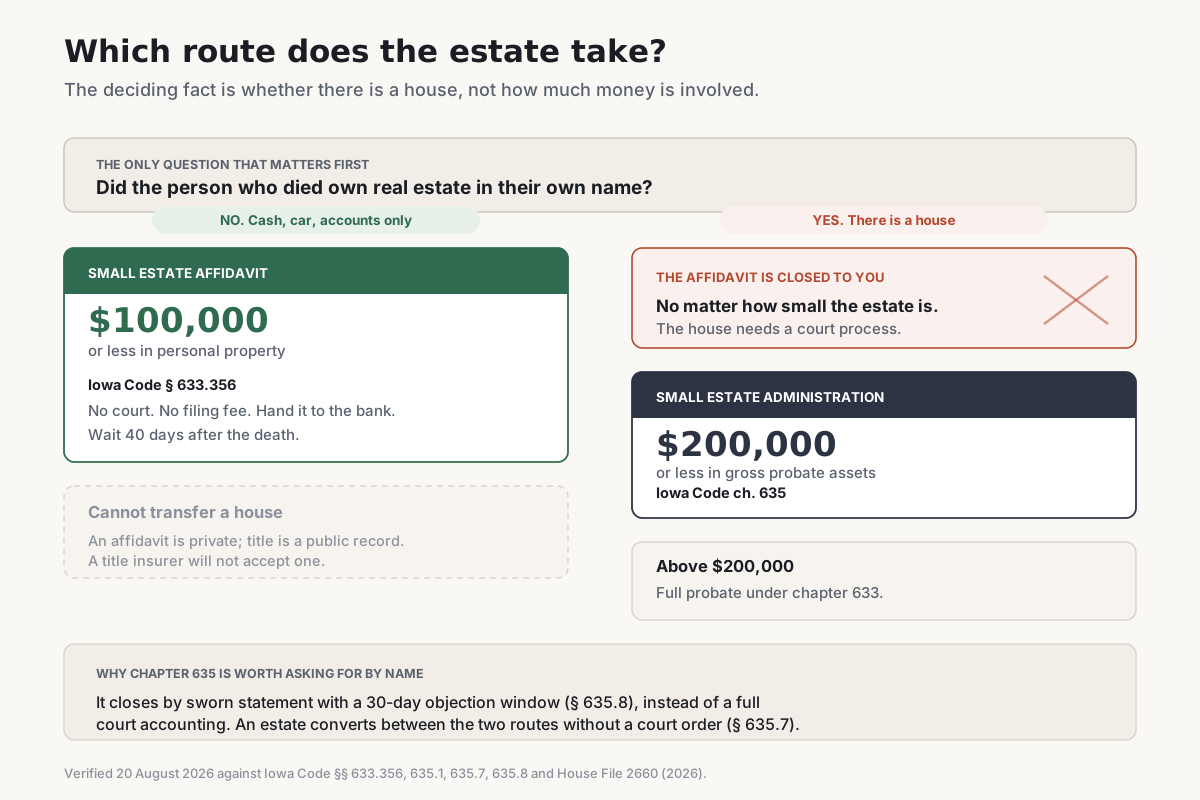
The three routes side by side
| Affidavit (§ 633.356) | Small estate administration (ch. 635) | Full probate (ch. 633) | |
|---|---|---|---|
| Ceiling | $100,000 personal property | $200,000 gross probate assets | No ceiling |
| Can it transfer a house? | No | Yes | Yes |
| Court involved? | No | Yes, but simplified | Yes |
| How it ends | Hand it to the bank | Sworn closing statement, 30-day objection window | Full accounting and court approval |
| Wait | 40 days after death | Creditor notice period applies | Creditor notice period applies |
| Realistic timeline | Days | Months | Six months to a year or more |
The line between the first two columns is not about money. A $40,000 estate with a small house in it uses chapter 635. A $90,000 estate that is all cash uses the affidavit. The house is the deciding fact, not the dollar figure.
What counts toward the limits
For the affidavit's $100,000, count only personal property that would otherwise pass by will or intestate succession. Gross value, so before subtracting debts: an account holding $80,000 counts as $80,000 even if the credit card bill is $30,000.
These do not count, because they never enter probate at all:
- Joint accounts with survivorship rights
- Payable-on-death and transfer-on-death accounts
- Life insurance and retirement accounts with a living named beneficiary
- Anything already in a trust
That last group is why estates are so often smaller, on paper, than families expect. A parent with a $150,000 account that has a POD designation on it has left nothing in probate at all.
Note that the affidavit's limit is measured "at any time since the decedent's death." A brokerage account that was worth $105,000 the week after the death and $95,000 now has already broken the ceiling.
The 40-day wait is the part that voids transfers
Present the affidavit before 40 days have passed and the bank can refuse it. Worse, a transfer made on a defective affidavit can be unwound, and because the affidavit is sworn under penalty of perjury, the person who signed it is personally exposed.
Count from the date of death, and wait the full period. There is no version of this that is worth rushing to save a fortnight.
What this means if you have inherited a house in Des Moines
Most people who land on this page are not really researching statutes. They have a house on the east side or in Beaverdale that belonged to a parent, and they are trying to work out how long they are stuck with it and what it is going to cost.
The honest sequence looks like this:
- Establish whether the house was in joint tenancy, in a trust, or subject to a life estate deed. The deed will tell you. If it was, you can skip most of what follows. A transfer on death deed is not an option in Iowa for real estate.
- Add up the probate assets. Under $200,000 gross and you are looking at chapter 635, not full probate. That is a materially faster and cheaper process, and it is worth making sure the attorney you speak to is opening it that way.
- Use the affidavit for the rest. The bank account and the car can often be dealt with separately, 40 days after the death, without waiting for the estate to close.
- Deal with the holding costs now, not at the end. Insurance, utilities, lawn, and the mortgage if there is one, all start immediately. Most homeowner policies restrict or void coverage once a house has been vacant for 30 or 60 days, and heirs usually discover this after the pipe bursts. Ring the insurer and ask for a vacant property endorsement.
You can sell the house during administration with the court's approval, rather than waiting for the estate to close. That is the single most useful thing to ask the estate's attorney in the first meeting, because it can save months of carrying an empty house.
When it comes to the sale itself, the full picture of your options, the tax position and how to handle siblings is in our guide to selling an inherited house in Iowa. The short version is that the stepped-up basis usually means you owe far less capital gains tax than you fear, and that listing with an agent gets the highest price if the house is in decent shape and you have the time.
If it is not, and you do not, that is the situation we exist for. We buy houses in the Des Moines metro as-is, contents and all, on a closing date you pick. You will get less than a listed sale would fetch, which is the honest trade. What you get back is no repairs, no showings, no commission, and no clearing out forty years of belongings from four hundred miles away. If you want a number to weigh against the alternative, start by looking up what Polk County has the house assessed at, which is free and takes a few seconds.
Common questions
Can I use a small estate affidavit to transfer a house in Iowa? No. The affidavit reaches personal property only. If the estate includes real estate that did not pass to a joint owner or through a trust, you need a court process, and if the estate is under $200,000 that process is chapter 635 small estate administration.
What is the limit for a small estate affidavit in Iowa? $100,000 in gross personal property, for affidavits presented on or after 1 July 2026. It was $50,000 before that.
Do I have to file the affidavit with the court? No. You present it directly to whoever holds the property, usually a bank. There is no court filing and no filing fee.
Do I need a lawyer? Not for the affidavit itself. For anything involving the house, yes, and specifically ask whether the estate qualifies for chapter 635. Iowa's statutory fee schedule is a ceiling rather than an entitlement, and courts routinely allow less than the maximum.
What if the estate is worth more than the limit? Above $100,000 in personal property, the affidavit is out. Above $200,000 in gross probate assets, chapter 635 is out and it is full chapter 633 administration. Section 635.7 lets an estate convert between the two if the inventory comes in differently from expected.
Can creditors still come after the assets? Yes. The successor takes the property subject to the decedent's valid debts and has to apply it to those debts before keeping anything. The affidavit is a collection mechanism, not a way to defeat creditors.
Is there an official state form? Iowa does not publish a single statewide fill-in-the-blank form for the affidavit. The statute itself sets out exactly what the document must contain, which matters more than the form it is printed on. House File 2660 did add a requirement that Iowa's child support services make a form available for the specific case where undistributed child support is the property being collected.
Last verified 20 August 2026 against the primary sources, each linked above: Iowa Code 633.356, 635.1, 635.7 and 635.8, and House File 2660 as enrolled. Every figure on this page was taken from those documents, not from another article. This is general information about how Iowa law works, not legal advice about your situation. Estate matters turn on facts we do not know about your family, and you should talk to an Iowa probate attorney before acting.
Wondering what your house is worth?
Polk County publishes an assessed value for every property in Des Moines. Type your address and see yours on screen. No sign-up, and nothing to give us.
Look up my house value