Selling a House With Tenants in It
You can sell with tenants in place, and you do not need their permission. What you cannot do is sell the tenancy away: the lease goes with the house. What Iowa law requires, what it lets you skip, and whether to wait out the term.
Selling an Inherited House in Iowa: Probate, Taxes and Your Options
You can sell a house in Iowa with tenants living in it. You do not need their permission, you do not need to wait for the lease to run out, and you do not need to get them out first.
What you cannot do is sell the tenancy away. The lease is attached to the property, not to you. Whoever buys the house buys the lease with it, on the same terms, until it ends on its own. That single fact decides your buyer pool, your price and your timeline, and most of this page follows from it.
If you are a tired landlord in Des Moines weighing whether to sell now or wait out the lease, this sets out what Iowa law requires, what it lets you skip, and where the honest trade sits.
Why the lease survives the sale
Iowa's landlord and tenant rules live in chapter 562A. The answer to "does my buyer have to honour the lease" is not in a section about selling. It is in the definitions.
Section 562A.6(5) defines a landlord as "the owner, lessor, or sublessor of the dwelling unit or the building of which it is a part". Not the person who signed the lease. The owner. When you sell, the buyer becomes the owner, and by that definition becomes the landlord, bound by the rental agreement already running.
That is why you cannot promise a buyer an empty house you do not yet have the right to empty.
Before you go looking for a clever lease clause: section 562A.11(1)(a) says a rental agreement shall not provide that either party waives rights or remedies under the chapter, and subsection 3 makes any such provision unenforceable. You cannot draft around these rules in advance.
Which tenancy you have decides everything else
Before you speak to an agent or a cash buyer, find the lease and read the first page. Three situations, and they behave completely differently.
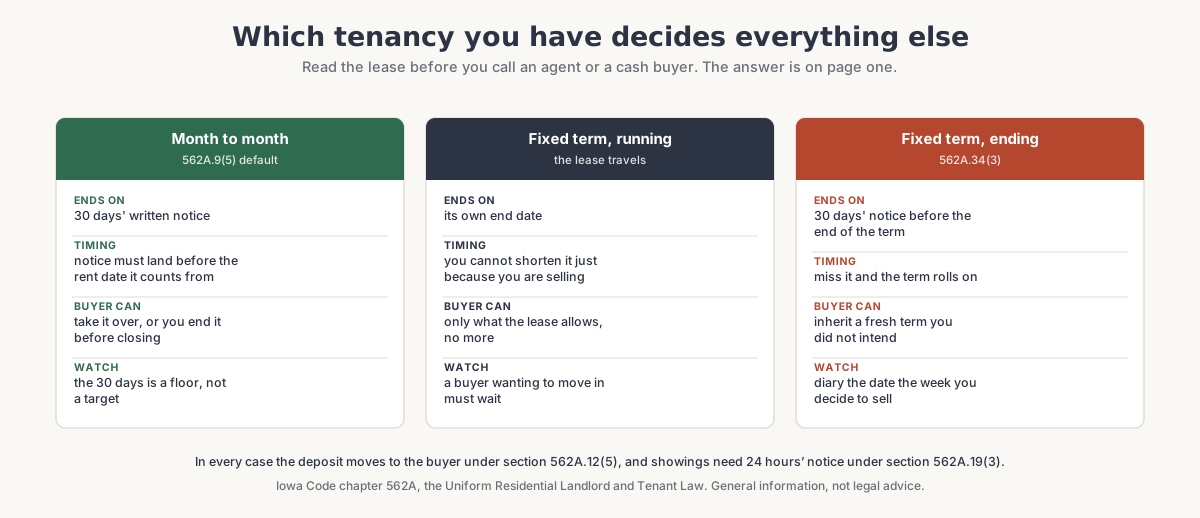
No written lease means you are almost certainly month to month. Section 562A.9(5) says that unless the rental agreement fixes a definite term, the tenancy is week to week for a roomer paying weekly rent and month to month in all other cases. Handshake arrangements, a lease that expired years ago, a relative paying towards the bills: all month to month.
Ending one takes written notice. Section 562A.34(2) requires at least thirty days' written notice before the periodic rental date specified in the notice. The thirty days runs to a rent date, not to any date you please: serve notice on the 5th and you are out at the next rent date at least thirty days away, not on the 4th.
If a fixed term is still running, it runs. Nothing in chapter 562A lets you cut one short because you have decided to sell. Selling is not a breach by the tenant and not a ground for possession.
If a fixed term is coming to an end, section 562A.34(3) gives either side at least thirty days' written notice before the end of the first or a subsequent term. Miss that window and the term rolls over, and you are selling a house with another full term attached. If you are thinking of selling, diary that date the same week.
Showings: the rule is 24 hours, and it is narrower than landlords think
Section 562A.19(1) says the tenant shall not unreasonably withhold consent for the landlord to enter to inspect, make repairs, or "exhibit the dwelling unit to prospective or actual purchasers". Showing the house to a buyer is expressly on the list, so a tenant who refuses all access is not on solid ground.
Subsection 3 is the other half: the landlord shall not abuse the right of access or use it to harass the tenant, and except in an emergency shall give at least twenty-four hours' notice and enter only at reasonable times.
Twenty-four hours, not forty-eight. More freedom than most landlords assume, but a floor rather than a target: a Saturday block of viewings agreed a week ahead sells the house better than the legal minimum served repeatedly.
Both sides have a remedy, and the tenant's has teeth. Under section 562A.35(1), if a tenant refuses lawful access the landlord can get an injunction or terminate, plus damages and attorney fees. Under subsection 2, if the landlord enters unlawfully, enters lawfully but unreasonably, or makes repeated lawful demands that have the effect of unreasonably harassing the tenant, the tenant can get an injunction or terminate, and recover actual damages of not less than one month's rent plus attorney fees.
Read those together and the strategy writes itself. Give proper notice, cluster the viewings, do not use access as pressure.
The retaliation trap
Section 562A.36 prohibits retaliation: a landlord may not retaliate by raising rent, cutting services, or bringing or threatening an action for possession after the tenant has complained to a government agency about a code violation affecting health and safety, complained to the landlord, or joined a tenants' union.
The part that bites is evidential. Evidence of a good faith complaint within one year before the alleged retaliation creates a presumption that the conduct was retaliatory, and the tenant gets actual damages, attorney fees, and a defence to a possession action.
So if your tenant reported a furnace problem in March and you serve a termination notice in September to get the house empty, you are inside that year and arguing against a presumption. Subsection 3 has exceptions, including where the tenant is in default in rent, but "I wanted a vacant house" is not one of them. Non-payment is a separate route: section 562A.27(2) lets a landlord terminate if rent is unpaid three days after written notice. That is a remedy for a rent default, not a way to clear a house for sale, and a court will hear the difference.
The deposit moves to the buyer, and there is a 20 day clock
This is the most-missed step in a tenanted sale, and the one that generates a claim months after everyone has moved on.
Section 562A.12(5) says that on termination of the landlord's interest, the landlord shall within a reasonable time either transfer the deposit, less any lawful deductions, to the successor in interest and notify the tenant of the transfer and the transferee's name and address, or return it to the tenant. Do that and subsection 5(b) ends your liability for it.
Subsection 6 then puts the obligation on the buyer, with a detail worth knowing: if the tenant does not object to the stated amount within twenty days after written notice of the amount transferred, the buyer's obligation to return the deposit is limited to the amount in that notice. The statute even requires the notice to contain a stamped envelope addressed to the successor.
So get the transfer and the notice in writing and keep the proof: that document is what ends your exposure. If a deposit quietly stays in your account after closing you are still on the hook, and section 562A.12(7) makes bad faith retention punishable by punitive damages up to twice the monthly rent, on top of actual damages.
Two related items. The duty to disclose who manages the premises and who accepts service binds a successor landlord under section 562A.13(2), so the buyer must make that disclosure. And a deposit cannot exceed two months' rent under section 562A.12(1), which occasionally surfaces at closing when an old deposit is bigger than anyone remembered.
Your buyer pool is the real decision
Here is the trade, plainly: a tenanted house sells to a smaller pool of buyers than an empty one. Someone buying a house to live in cannot move into yours until the tenancy ends. If your tenant has eight months left on a fixed term, that buyer is gone whatever they think of the kitchen. What is left is investors, who are buying the income rather than the house, and who price on the rent, the condition, and whether the tenant pays:
| What you have | Who will buy it | What tends to happen to the price |
|---|---|---|
| Good tenant, at market rent, paperwork in order | Investors, and a decent number of them | Often no discount at all. You are selling an asset that already works |
| Good tenant, well under market rent | Investors, pricing off the actual rent | Discounted, because the buyer inherits your below-market lease |
| Tenant behind, or a dispute running | Fewer buyers, mostly cash | Discounted, sometimes heavily |
| Month to month, cooperative tenant | Investors and, with notice served, owner-occupiers | Closest to a normal sale, because the buyer can choose |
| Empty at closing | Everyone | Full retail pool, but you carry the vacancy and the turn cost |
The row that surprises people is the second. A tenant paying $300 under market on a lease with a year to run is not a neutral fact, it is a discount the buyer will quantify and deduct. Below-market rent on a long lease is the most expensive kind of good tenant.
Where in Des Moines this actually matters
Whether the owner-occupier pool is worth chasing depends on where the house is. We have ingested the Polk County assessor's records, 183,474 parcels, of which 69,503 are Des Moines residential above $10,000. By postcode:
| Postcode | Houses | Share under $150,000 | Average assessment |
|---|---|---|---|
| 50314 | 2,665 | 69.2% | $134,902 |
| 50316 | 4,846 | 51.3% | $149,026 |
| 50317 | 13,657 | 36.3% | $178,535 |
| 50315 | 11,909 | 26.1% | $190,471 |
| 50311 | 3,886 | 14.9% | $233,381 |
| 50312 | 5,354 | 10.8% | $357,857 |
| 50310 | 10,868 | 9.5% | $234,877 |
| 50321 | 1,963 | 5.0% | $358,266 |
69.2% of houses in 50314 are assessed under $150,000, against 5.0% in 50321. A fourteenfold difference inside one city, and it changes the answer to "should I get it empty first".
In the cheaper postcodes the buyer pool is investor-weighted anyway, so a paying tenant is closer to an asset than an obstacle, and emptying the house may buy you a month of vacancy to reach buyers who were never going to pay much more. In 50312 or 50321, where most stock is well above $150,000, owner-occupiers are the market and a tenancy that blocks them is expensive.
These are assessments, not sale prices, and assessment lags the market. For a closer read on your own house, see what your house is worth.
The tax bill is different from a normal house sale
Selling a rental is not taxed like selling your home, and two things catch people out. General information, not tax advice, and worth half an hour with an accountant.
Depreciation comes back. If you claimed depreciation while renting the property out, that part of the gain is taxed on sale. Topic no. 409 states that the portion of any unrecaptured section 1250 gain from selling section 1250 real property is taxed at a maximum 25% rate, above the usual 0, 15 and 20 per cent capital gains rates; Publication 544 covers the mechanics. The trap: it applies to depreciation "allowed or allowable", so if you rented the house out and never claimed it, the calculation can still assume you did.
The home sale exclusion may not be there. If this was once your own home, you may be counting on the $250,000 exclusion, or $500,000 filing jointly. Topic no. 701 sets the test: you generally must have owned the home at least 24 months of the last 5 years, and used it as your residence at least 24 of those months, ending on the sale date. That is the clock accidental landlords lose track of: rent for three years and you are near the edge, rent for four and it is usually gone. Even where it applies, Publication 523 is clear you cannot exclude the portion of gain equal to section 1250 depreciation adjustments allowed or allowable after 6 May 1997.
If you are heading past that three year mark and were always going to sell, the timing is worth real money, and a better reason to move than a tenant you find annoying.
So should you sell now, or wait?
Wait for the lease to end if: the house is in a postcode where owner-occupiers are the market, the tenant is reasonable, the term ends in a few months, and you can carry it until then. An empty house reaches the full buyer pool and will probably beat any investor number.
Sell with the tenant in place if: the tenancy has a long way to run, the rent is at market and the tenant pays, or you are simply done being a landlord. A good tenant at market rent is an asset to the right buyer, and you get paid without the vacancy.
Sell to a cash buyer if: the house needs work you are not going to do, the tenancy is a mess, or you need a date certain. That is where we fit, and the trade is the ordinary one: we pay less than the open market. If the tenant pays and the house is sound, an agent will very likely beat us, and you should let them. How it works sets out our process and the questions we get asked covers the rest.
One thing we will not do, and be wary of anyone who offers: promise you an empty house on a date the tenancy does not allow. A buyer who says they will "take care of" a fixed-term tenant is describing either a cash-for-keys negotiation the tenant is free to refuse, or something worse. The checks worth running before you sign with any cash buyer apply here as they do to any sale.
Two questions we get asked
Do I have to tell my tenant I am selling? Chapter 562A does not require an announcement. But you need access for viewings, and section 562A.19(3) makes each one a notice event. They will find out immediately, so telling them yourself is better.
Should I offer the tenant money to leave early? It is a negotiation, not a right, and the tenant can say no. Weigh it against the vacancy and the turn cost. In a low-value postcode it often does not pay for itself.
The short version
The lease travels with the house, so your buyer inherits it. A fixed term runs to its end; a month to month can be ended on thirty days' written notice to a rent date. Showings need twenty-four hours' notice, and abusing access costs at least a month's rent. The deposit must be transferred to the buyer in writing, and the tenant has twenty days to object to the figure.
Last verified 3 September 2026 against Iowa Code chapter 562A, specifically sections 562A.9, 562A.11, 562A.12, 562A.13, 562A.19, 562A.27, 562A.34, 562A.35 and 562A.36, and against IRS Topic no. 409, Topic no. 701, Publication 523 and Publication 544. This is general information about Iowa law, not legal or tax advice for your situation.
Wondering what your house is worth?
Polk County publishes an assessed value for every property in Des Moines. Type your address and see yours on screen. No sign-up, and nothing to give us.
Look up my house valueMore on inherited property

The Iowa Small Estate Affidavit Will Not Transfer a House. Here Is What Does
Iowa's small estate affidavit covers up to $100,000 of personal property as of July 2026, but it cannot transfer real estate at all. If the estate includes a house, the route you want is chapter 635 small estate administration, and its ceiling is $200,000.

How Long Does Probate Take in Iowa? Six Months Is the Floor
Iowa probate runs six to twelve months, and the reason for the floor is a four month creditor claim window set by statute. But you do not have to wait for the estate to close to sell the house, and most families should not.