Selling an Inherited House in Iowa: Probate, Taxes and Your Options
What has to happen before an inherited house can be sold in Iowa, what you will actually owe in tax, and how to handle siblings who disagree or a house you live four hundred miles from.
How to Sell Your House Fast: Every Route, Honestly
Inheriting a house is not like buying one. You did not choose it, you probably did not want it, and you are being asked to make decisions about it during the worst few months of your life.
This guide covers what actually has to happen before an inherited house in Iowa can be sold, what you will owe in tax (for most people, far less than they fear), and how to handle the two situations that cause the most trouble: siblings who disagree, and a house four hundred miles away that is filling up with mail.
Can you sell an inherited house right away?
Usually not immediately, and the reason is ownership. Until the estate transfers the house to you, you do not own it, and you cannot sell what you do not own. That transfer is what probate does.
There are three common ways the house skips probate entirely:
- It was held in joint tenancy with right of survivorship. Ownership passes to the surviving owner automatically. Very common between spouses.
- It was in a living trust. The trustee can sell it without the court.
- It was subject to a life estate deed recorded while the owner was alive. Note that Iowa, unlike every state bordering it, has no transfer on death deed for real property. Chapter 633D covers securities and investment accounts, not land, so a house cannot pass that way here.
If none of those apply, the house goes through probate, and in Iowa that means a court process. Iowa's small estate affidavit cannot be used when the estate contains real estate at all, whatever the estate is worth, so a house rules it out on its own. What a house does not rule out is Iowa's simplified small estate administration under chapter 635, which is open to estates with gross probate assets of $200,000 or less and closes by sworn statement rather than a full court accounting. It is still a court process, but it is a materially faster one, and it is worth asking for by name.
So for most people reading this: probate, and a wait.
How long probate takes in Iowa
Six months is the practical floor and a year is common. Our full month by month breakdown of the Iowa probate timeline sets out where the time actually goes. Two things set that pace. Iowa requires notice to creditors, and creditors get a statutory window to file claims. The estate cannot close until that window shuts. Then the court has to approve the sale and the final accounting.
You can often sell during probate rather than waiting for it to close, with the court's approval. That is worth asking the estate's attorney about early, because it can save months. The court procedure for selling a house in probate runs petition, notice, order, report, confirmation, and a power of sale in the will can skip nearly all of it.
What you will actually owe in tax
This is where most people are carrying fear they do not need. Three separate taxes get confused with each other constantly.
Iowa's inheritance tax no longer exists
Iowa repealed it. Under Iowa Code section 450.98, the inheritance tax does not apply to the estates of people who died on or after 1 January 2025. It was phased out over four years, with the rate reduced by 20% each year from 2021, and it is now gone.
If the death was in 2024 or earlier, the old rules still apply to that estate, and the rate depends on how closely you were related. Direct descendants, so children and grandchildren, were exempt even then.
You may still read older articles listing Iowa among the inheritance tax states. They are out of date.
Federal estate tax will not apply to you
The federal estate and gift tax exemption is $15 million per person for 2026, $30 million for a married couple. It is paid by the estate, not by you, and fewer than one estate in a thousand owes it. A house in Des Moines does not get you near the threshold.
Capital gains: the stepped-up basis is the part that matters
This is the one that saves people real money, and the one most heirs have never heard of.
When you inherit property, your cost basis is not what the deceased paid for it. It resets to the fair market value on the date of death. That is the stepped-up basis, and it means decades of appreciation are simply never taxed.
An example with numbers:
Your father bought the house on the east side in 1987 for $62,000. He died in March, when it was worth $210,000. You sell it in August for $218,000.
Your basis is $210,000, not $62,000. Your taxable gain is $8,000, not $156,000.
Selling costs come off that too, so the real figure is usually lower still.
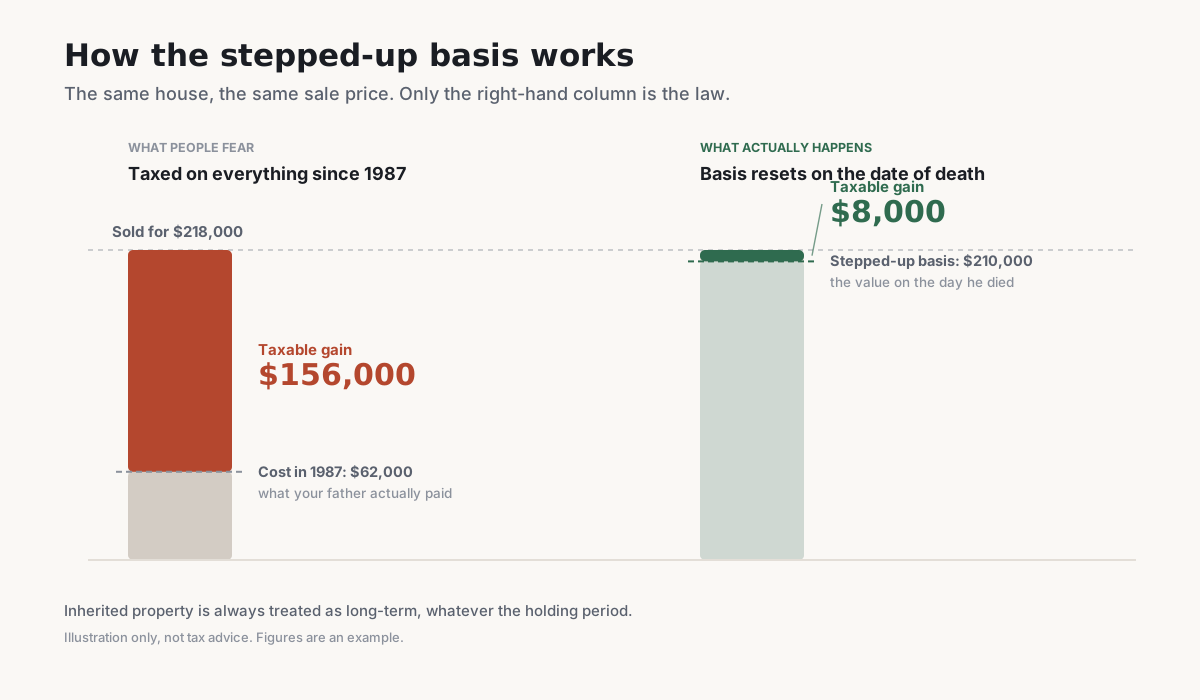
Sell soon after the death and the gain is often near zero, occasionally a small loss. Hold the house for five years while it appreciates and you will owe capital gains on the growth since the death, which is why "we will deal with it later" has a price attached.
Inherited property is always treated as long-term, whatever the holding period, so it is taxed at long-term rates rather than as ordinary income.
The number this all rests on is the date-of-death value, so get it documented properly. A formal appraisal is the strongest evidence. You can start by looking up what Polk County has on record for the address, which is free and takes a few seconds, but note that an assessed value is not an appraisal and the IRS will want the latter if the figure is ever questioned.
None of the above is tax advice. It is the general shape of the rules. Talk to a CPA about your actual return.
Selling an inherited house with siblings
The tax questions have clean answers. This one does not, and it is what actually derails inherited house sales.
If three of you inherit the house equally, you each own an undivided third. Not a room each. No one can sell, rent or move in without the others, and any one of you can block a sale indefinitely.
Four situations, in rough order of how often we see them:
Everyone agrees to sell. Straightforward. The estate sells, costs and debts come out, the balance splits by share. Agree in advance and in writing who pays the insurance, the utilities and the lawn while it sits, because those bills start immediately and someone will be fronting them.
One sibling wants to keep it. They buy the others out. Get an independent appraisal, because the sibling who wants it will value it low and the ones who do not will value it high, and a third-party number costs a few hundred dollars and prevents years of resentment. If they cannot pay cash they will need a mortgage or an estate loan, and the buyout terms should be written down even between people who trust each other.
One sibling is living in it. This is the hardest. They may see it as home; the others see an asset earning nothing. Whether they should pay rent to the estate is a real legal question, not just a family one, and the answer depends on the will and on Iowa law. Get advice early, before it becomes a grievance.
No one can agree. Any co-owner can file a partition action, and the court will order the property sold and the proceeds divided. It works, and it is a bad outcome: it costs legal fees, it takes months, it usually produces a lower price, and families rarely recover from it. It is the option that exists so that the threat of it can push people to a deal.
What if the house still has a mortgage?
The debt does not die with the borrower. The house comes to you with the loan attached, and the payments need to keep being made or the lender can foreclose, which does not pause for probate.
The good news is federal law is on your side here. The Garn-St. Germain Act (12 U.S.C. 1701j-3) stops a lender enforcing a due-on-sale clause when property passes to a relative on death. They cannot demand the full balance just because the owner died. Contact the servicer early, tell them what has happened, and ask what they need. They deal with this constantly.
If the balance is higher than the house is worth, selling normally will not clear the debt, and you are looking at a short sale or a deed in lieu. That is a different article, and it needs an attorney.
Your options for selling
List it with an agent
The right answer when the house is in decent shape, you are not in a hurry, and the estate can carry the costs while it sits. It produces the highest price. It also means repairs, cleaning, staging, showings, sixty to ninety days on market, and about 5 to 6% in commission. If you live in Des Moines and have the time, list it. On a house with a real repair bill, check how much of your assessed value is land before committing to the work.
Sell it as-is to a cash buyer
You get less. That is the trade and anyone who tells you otherwise is selling you something. What you get back is a closing date you choose, no repairs, no showings, no commission, and no chance of a buyer's financing collapsing three weeks in. We have put the arithmetic of selling it fast on its own page, worked through on a $200,000 house, including the four months of carrying costs that narrow the gap.
This is the right call in a narrow set of situations that inherited houses fall into constantly: you live out of state, the house needs work beyond your appetite, it is full of forty years of belongings, or the siblings need it done and dividing a cheque is easier than co-managing a renovation from three cities.
For sale by owner
Saves the listing commission, costs you the time and the buyer pool. In an inherited sale, where the seller is usually grieving, busy and often far away, FSBO tends to be a false economy.
Auction
Fast and public, and price is genuinely unpredictable. Sometimes used when the court requires a transparent process.
The problems that come with inherited houses specifically
It is full of belongings. This stops more sales than any other single thing, because it is emotional labour rather than a transaction. Take what matters, get an estate sale company for what is saleable, and know that a cash buyer will take it as-is, contents and all, if that is the wall you are stuck at.
It has been empty for months. Empty houses go downhill fast. Check the insurance immediately: most homeowner policies restrict or void coverage once a house is vacant beyond 30 or 60 days, and heirs discover this after the burst pipe. Ask the insurer for a vacant property endorsement.
It needs more work than you thought. Get an inspection before you decide anything. Knowing whether it is $8,000 or $80,000 changes which of the options above makes sense.
You live in another state. Everything is harder and more expensive at distance. Flights, a property manager or a neighbour doing you favours, and every decision needing a trip. This, more than condition, is why out-of-state heirs sell as-is.
Frequently asked questions
Do I have to pay taxes on an inherited house if I sell it? Usually very little. Iowa's inheritance tax is repealed for deaths on or after 1 January 2025, federal estate tax only applies above $15 million, and the stepped-up basis means capital gains are calculated from the date-of-death value rather than what the deceased paid. Sell soon after the death and the taxable gain is often close to zero. Our full breakdown of which taxes apply to an inherited house in Iowa goes through all six, including the property tax and homestead credit points that catch people out.
How long do I have to sell an inherited house? There is no deadline. The practical pressure is the carrying cost: mortgage, insurance, property tax and utilities run the whole time, and the longer you hold it the more capital gains you may accrue on appreciation since the death.
Can I sell before probate is finished? Often yes, with court approval, though the sale usually cannot close until the estate has authority to convey title. Ask the estate's attorney in the first month, not the sixth.
What happens if one sibling refuses to sell? Nothing, until you resolve it. Co-owners cannot sell without agreement. A buyout is the usual answer; a partition action is the court-ordered fallback, and it is slow, expensive and hard on families.
Is it better to sell or rent it out? Renting suits people who want the income, live near enough to manage it, and can absorb a bad tenant, though it does make selling later a different job. It also means giving up the clean stepped-up basis position as the property appreciates. Selling suits people who want it finished. Most heirs, in our experience, badly overestimate their appetite for being a landlord.
Who pays the closing costs? On an ordinary Iowa sale the estate pays the seller's side: abstract continuation, transfer tax and the agent's commission. When you sell to a cash buyer there is no agent and no lender, so most of those line items do not arise.
Where to start
If you are early in this and the house is in the Des Moines metro, do these three things before making any decision about selling:
- Find out whether the estate needs probate, and if so, get it opened. Nothing can happen until it is.
- Establish the date-of-death value. It sets your tax position and you cannot reconstruct it convincingly later.
- Check the insurance, especially if the house is empty.
Then work out which of the options above your situation actually calls for. If the house shows well and you have time, list it. That is genuinely the better outcome for most people and we would rather say so.
If it does not, or you are out of state, or the siblings just need it over, we buy houses in the Des Moines metro as-is, including houses in probate and houses full of belongings. You can look up what Polk County has on record for the address first, free, without speaking to anyone.
Last verified 20 August 2026 against Iowa Code 450.98 (inheritance tax repeal), Iowa Code 633.356 and Iowa Code 635.1 (the two small estate routes), and the IRS figure for 2026. This is general information about how Iowa law works, not legal or tax advice about your situation.
Wondering what your house is worth?
Polk County publishes an assessed value for every property in Des Moines. Type your address and see yours on screen. No sign-up, and nothing to give us.
Look up my house valueMore on inherited property

The Iowa Small Estate Affidavit Will Not Transfer a House. Here Is What Does
Iowa's small estate affidavit covers up to $100,000 of personal property as of July 2026, but it cannot transfer real estate at all. If the estate includes a house, the route you want is chapter 635 small estate administration, and its ceiling is $200,000.

How Long Does Probate Take in Iowa? Six Months Is the Floor
Iowa probate runs six to twelve months, and the reason for the floor is a four month creditor claim window set by statute. But you do not have to wait for the estate to close to sell the house, and most families should not.