Cash Buyer Red Flags: What to Check Before You Sign
Iowa does not licence cash home buyers, so the checks are yours to run. The paperwork rules that do exist, the red flags in the order they cost you money, and seven checks you can do in an afternoon. Including the ones we would fail.

Selling an Inherited House in Iowa: Probate, Taxes and Your Options
Most "we buy houses" companies in Des Moines are ordinary small businesses, though it is worth knowing what the three businesses behind that pitch actually are. A few are not, and Iowa has two chapters of law written specifically because of what the few did to homeowners in trouble.
We are a cash buyer, so read this as a page written by an interested party. That is exactly why it is worth naming the things we would fail on as well. Every check below is one you can run on us.
The short answer
There is no licence to be a cash home buyer in Iowa. Anyone with a phone can print a sign. So the protection you have is not a regulator vetting the company in advance. It is a handful of statutory rights, and the paperwork.
Three things matter more than anything else a buyer tells you:
- Who actually holds the money, and can you see it.
- Whether the person is buying, or reselling your contract to somebody else.
- Whether the price can move after you sign.
If the answers are clear and written down, most of the risk is gone. If any of them is vague, the offer price is irrelevant.
The one situation Iowa law treats differently
Almost everything on this page is general good practice. This part is not. If you are behind on payments and your house is in or near foreclosure, you are covered by rules that do not apply to any other seller, and they are strict. Before selling at all, check what can still stop the foreclosure.
Iowa has two separate chapters here and it helps to know which is which.
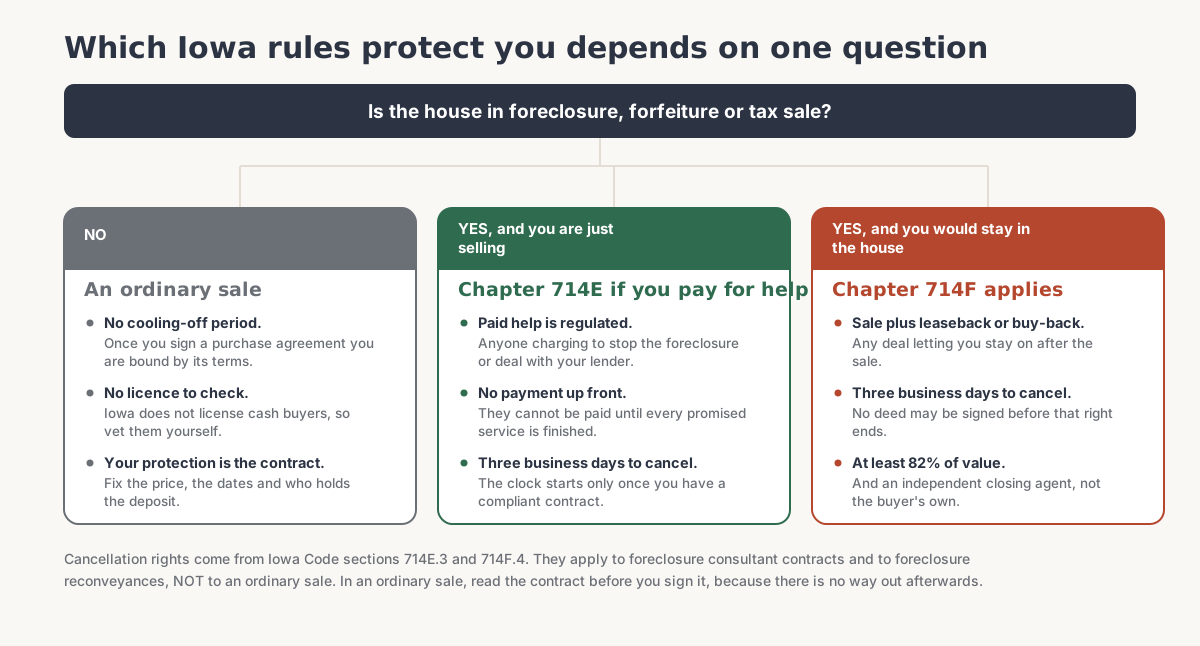
Chapter 714E covers foreclosure consultants, meaning anyone who takes payment to stop a foreclosure, negotiate with your lender, arrange a repayment plan, or help you redeem the property. Section 714E.1 defines the role broadly, and it catches people who never use the phrase.
The protections are blunt. Under section 714E.4, a foreclosure consultant may not take any payment until they have completely finished every service they promised. They may not take a lien on your property to secure their fee, and any such security is void. They may not take a power of attorney from you, except to inspect documents. They may not acquire an interest in your house, directly or through an affiliate, if they have a contract with you.
The contract itself has a required shape. Section 714E.2 requires it in writing, with a notice in at least fourteen point boldface type stating that the consultant cannot take money from you until the work is done and cannot ask you to sign any lien, mortgage or real estate contract. Section 714E.3 gives you three business days to cancel, and the clock does not start until they have given you a compliant contract and a detachable cancellation form.
Chapter 714F covers foreclosure purchasers, and this is the one that catches a cash buyer. It applies where you sell your home while in foreclosure and get to stay in it, whether that is dressed up as renting it back, an option to buy it back, or a contract for deed. Section 714F.1 calls this a foreclosure reconveyance.
If someone offers you that deal, these are your rights and they are not negotiable.
- The contract must be written in at least twelve point boldface type and signed by both of you before any deed is signed, under section 714F.2.
- It must state the total consideration, when possession transfers, and the full terms of any arrangement letting you stay, under section 714F.3. It must carry a notice in fourteen point boldface type saying that until your right to cancel has ended, they cannot ask you to sign a deed.
- You have until midnight of the third business day to cancel, under section 714F.4.
- Under section 714F.8, the buyer must verify you can actually afford the buy-back, the closing must be handled by a closing agent who is not their employee or affiliate, and if you end up leaving the property they must pay you enough that you have received at least eighty-two per cent of its fair market value.
- You cannot sign these rights away. Section 714F.6 makes a waiver void, with one narrow exception where a sale is genuinely happening inside those three days through no fault of the buyer.
- A clause forcing you into arbitration is void at your option under section 714F.7.
The enforcement is real. A violation is an unlawful practice under section 714.16, the consumer fraud statute, and section 714F.9 says a court that finds a violation shall award you actual damages, equitable relief, costs and your attorney's fees, and may add exemplary damages of at least one and a half times your actual damages.
So the practical rule is simple. If you are in foreclosure and a buyer proposes any arrangement where you stay in the house afterwards, that is a regulated transaction. If the paperwork does not look like the description above, something is wrong. Take it to a lawyer before you sign, not after.
One more thing before you panic-sell. Your lender has to give you a notice of right to cure and thirty days to fix the default before it can even start foreclosing on a one or two family home you live in, under section 654.2D. You usually have more time than the person knocking on your door implies, and the Iowa foreclosure process runs on a timeline you can see, from the federal 120 days through to redemption after the sale.
The red flags, in the order they cost you money
The price that moves after you sign
This is the commonest problem by a wide margin, and it is not a scam so much as a business model. You get a strong number, you sign, you tell your family, you book the movers. A week before closing an inspection turns up something and the price drops.
The fix is two lines in the contract. Make the offer as-is with an inspection window that ends on a fixed date, not on the buyer's satisfaction. And write in that the price does not change for anything visible on the day the offer was made. A buyer who intends to close will agree, because they already priced the roof.
No proof of funds, or proof that proves nothing
Ask for a bank statement or a letter from the institution holding the money, dated within the last month. What you are checking is that the money exists, in an account belonging to the party named on your contract.
A screenshot is not proof. A letter from an affiliate you have never heard of is not proof. "We are funded by our investor network" is a description of somebody else's money.
Nobody neutral is holding the deposit
This one is quietly important. Iowa requires a licensed real estate broker to keep money belonging to others in a trust account at a federally insured depository, under section 543B.46. A cash buyer purchasing on their own account is not a broker and has no such duty.
So do not hand earnest money to the buyer. Have the title company or the closing attorney hold it, and put that in the contract.
You cannot tell who you are actually selling to
Some buyers sign a contract and then sell the contract on to somebody else for a fee. That is wholesaling, the assignment is the product, and the practical effect is that you have no buyer at all until they find one.
Iowa draws a line here. A person who negotiates a sale of real estate for another for compensation is a broker under section 543B.3. Section 543B.7(1) excludes someone dealing as owner or genuine prospective purchaser, but only where they are not making repeated and successive transactions of a like character. Where the commission finds an unlicensed person has acted as a broker, section 543B.34(3) requires a cease and desist order and a civil penalty of up to the greater of $10,000 or ten per cent of the sale price.
That constrains them. It does not protect your timetable. Ask directly: are you buying this house, or assigning the contract? Then read the contract for the word assign, and for "and/or assigns" after the buyer's name. Assignment is not automatically wrong, and some wholesalers do it competently and say so up front. What you are entitled to is knowing which one you are dealing with.
Signing something you have not read, today
Urgency is the tool that makes every other red flag work. An offer that genuinely expires tonight is rare. An offer that expires tonight and comes with a document you have not read is the pattern.
Two things to refuse outright. Do not sign a deed at the kitchen table: a deed transfers your house, a purchase agreement does not, and real closings happen at a title company or a lawyer's office. And do not sign anything giving someone power of attorney over your property.
The memorandum you did not notice
Watch for a buyer recording a memorandum of your purchase agreement against the title. It is a document filed at the county recorder announcing that they have a claim on your house. Under section 558.41, a recorded instrument affects later purchasers who buy without notice, which is precisely why it works: a cloud on the title can stop you selling to anyone else until it is cleared.
If a contract gives the buyer permission to record anything against your property, ask why, and strike it if the answer is thin.
What a normal Des Moines cash purchase looks like
So you can compare. The steps are on our how it works page, but in outline:
| Stage | What should happen | What should not |
|---|---|---|
| First contact | Questions about the house, its condition and who has authority to sign | A price before anyone has seen it |
| The offer | In writing, as-is, naming the buying entity | "Around" a number, verbally |
| Earnest money | Deposited with a title company or closing attorney | Paid to the buyer directly |
| Between signing and closing | Title search, payoff figures, any court approval needed | A renegotiation |
| Closing | At a title company or attorney's office, funds by wire or cashier's cheque | At your kitchen table |
Two weeks is realistic where title is clean and authority is already in place. Faster is possible but uncommon.
Seven checks you can run in an afternoon
None of these need a lawyer.
- Look the company up on the Iowa Secretary of State's business search. Check that the entity named on your contract exists, is in good standing, and has a registered agent. One registered last month is not disqualifying, but it is worth a question.
- Match the name on the contract to the name on the proof of funds. These should be the same legal entity. Different names is the single most useful signal on this page.
- Ask which title company they use, then ring the title company. Ask whether they have closed with this buyer before. A real buyer has a relationship there.
- Search the buyer's name plus "assignment" and plus your county. Public records and court dockets say more than reviews do.
- Ask for two sellers they have closed with in the last year, and ring them. A buyer who has closed will have them.
- Read the contract for: assign, memorandum, option, non-refundable, and any inspection period that ends when the buyer decides. Those five words are where the trouble lives.
- Get a second number. A listing opinion from an agent, or a second cash offer. It helps to know how offers are calculated before you compare two of them. Not to play them off, but because one number tells you nothing. Our what is my house worth page is a starting point, and you should still get an agent's view.
Where we would fail your checks
Fair is fair.
We are a small operation, not a national brand, so a search for our name will not return pages of coverage. We buy at a discount, and on a house in good condition an agent will usually beat our number once you account for the commission and the repairs. We cannot promise a seven day closing on an estate that has not yet got authority to sign. And if you ask for references you get a short list, because we are not closing hundreds of houses a year.
If those are dealbreakers, list the house. That is the right answer more often than a page like this usually admits.
Frequently asked questions
Are "we buy houses" companies a scam? Mostly no. There is no licensing regime for cash buyers in Iowa, so the industry holds both careful operators and careless ones, and the checks above separate them faster than reputation does.
Can I cancel after I sign? Usually not, and this is the most misunderstood point on the page. An ordinary purchase agreement has no cooling-off period. The three business day cancellation rights in section 714E.3 and section 714F.4 apply to foreclosure consultant contracts and foreclosure reconveyances, not to a normal sale. Read before signing, because afterwards your options are whatever the contract gives you.
A buyer wants me to sign a deed now and says the paperwork follows. Is that normal? No. Refuse. In a foreclosure reconveyance it is expressly prohibited until your cancellation right has ended, under section 714F.3. In any other sale there is no reason for it.
What if the buyer just disappears after we sign? Then you have a contract and they have your house tied up. This is why the earnest money should sit with a neutral party and why the contract needs a date by which they must close.
Is a low offer a scam? No. A low offer is an offer and you can decline it. What deserves suspicion is a high offer that falls shortly before closing.
Do I need a lawyer to sell to a cash buyer? Not usually for a straightforward sale. Yes, if you are in foreclosure, if anyone proposes you stay in the house after selling, or if you do not understand a document you are being asked to sign.
Where do I complain? The Iowa Attorney General's consumer protection division takes consumer complaints, and a violation of chapter 714E or 714F is an unlawful practice under section 714.16. Section 714F.9 also lets you bring your own action, with attorney's fees if you win.
The short version
Ask who holds the money. Ask whether they are buying or assigning. Lock the price against the condition they have already seen. If you are in foreclosure and anyone suggests you can stay in the house after selling it, treat chapter 714F as a checklist and get a lawyer.
Then get more than one number. Ours is one of them, and our FAQ explains how we reach it. If you would rather know who you are talking to first, that is about us.
Last verified 27 August 2026 against the primary sources linked above: Iowa Code 543B.3, 543B.7, 543B.34, 543B.46, 558.41, 654.2D, 714.16, 714E.1, 714E.2, 714E.3, 714E.4, 714F.1, 714F.2, 714F.3, 714F.4, 714F.6, 714F.7, 714F.8 and 714F.9. This is general information about how Iowa law works, not legal advice about your situation, and you should talk to an Iowa attorney about your own facts.
Wondering what your house is worth?
Polk County publishes an assessed value for every property in Des Moines. Type your address and see yours on screen. No sign-up, and nothing to give us.
Look up my house value