How Long Does Probate Take in Iowa? Six Months Is the Floor
Iowa probate runs six to twelve months, and the reason for the floor is a four month creditor claim window set by statute. But you do not have to wait for the estate to close to sell the house, and most families should not.

Selling an Inherited House in Iowa: Probate, Taxes and Your Options
Six months is the floor. A year is normal. That is the honest answer, and the reason for the floor is a single statutory clock that nothing you do can shorten.
Iowa gives creditors four months from the second published notice to file claims against the estate. Until that window closes, the estate cannot safely distribute anything, because a claim filed in month four has to be paid before the heirs get their share. Everything else in probate can be hurried. That cannot.
So if you have inherited a house in Des Moines and you are trying to work out when you can actually sell it, the useful question is not really how long probate takes. It is whether you have to wait for probate to finish at all. Usually you do not, and that is the part most pages on this subject never get to. Once you can sell, how fast a sale can really go turns on four separate clocks, and a cash buyer only stops two of them.
The timeline at a glance
| Stage | When it happens | What sets the pace |
|---|---|---|
| File the petition, appoint the representative | Weeks 1 to 4 | How quickly the family acts |
| First and second publication of notice | Weeks 2 to 6 | Newspaper schedule, two consecutive weeks |
| Creditor claim window runs | Four months from the second publication | Statute. Cannot be shortened |
| Report and inventory filed | Within 90 days of appointment | Statute, extendable by the court |
| Sell the house | Any point after appointment, with court approval | Your decision, not the estate's closing date |
| Debts, taxes, final report | Months 5 to 9 | Complexity of the estate |
| Closing and discharge | Months 6 to 12 | Court calendar, objections |
An estate with one house, one bank account, an agreed family and no disputes closes near the bottom of that range. Add a will contest, an heir nobody can find, a farm, a business, or siblings who are not speaking, and you are into a second year.
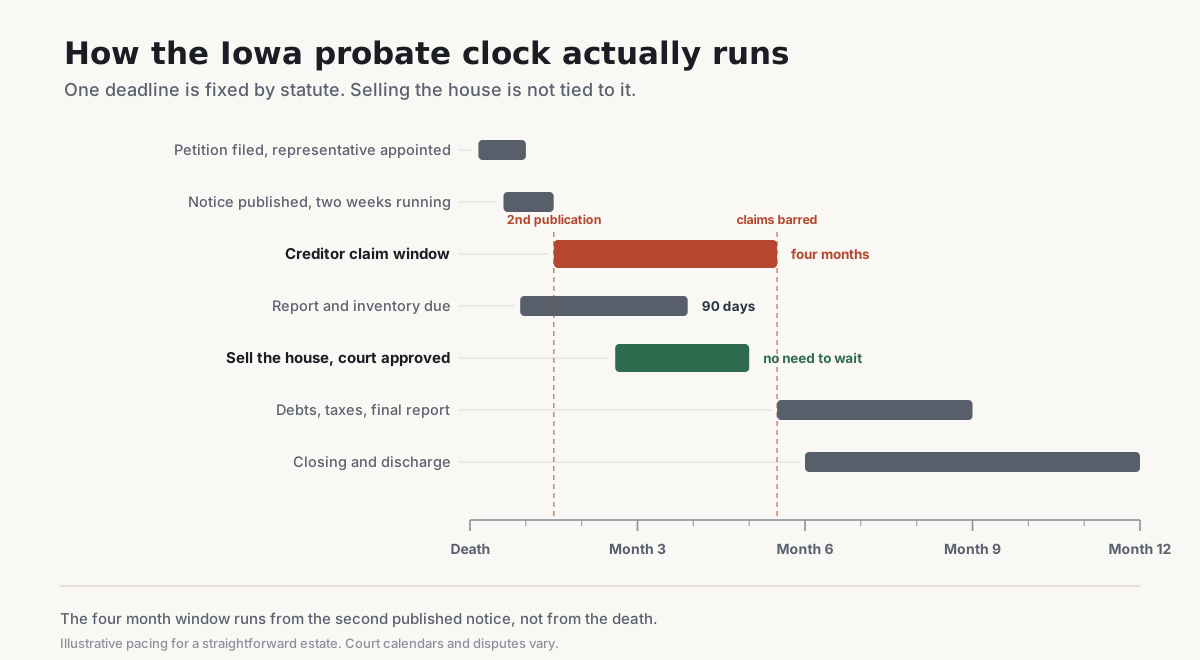
The four month creditor clock is the real floor
This is the single fact that explains why Iowa probate cannot be done in eight weeks, however organised you are.
When the personal representative is appointed, they publish a notice in a newspaper of general circulation in the county where the estate is pending, once a week for two consecutive weeks. In Polk County that is a Des Moines publication. From the date of the second publication, the clock starts.
Under Iowa Code section 633.410, claims against the estate are forever barred unless filed within the later of four months after the second publication, or, for any creditor whose identity is reasonably ascertainable, one month after notice is posted to them by ordinary mail.
Read that "later of" carefully, because it catches people out. If you discover a creditor in month four and post their notice then, that creditor has a month from the mailing, which lands you past the four month mark. Doing a thorough job of identifying creditors early is what keeps the two deadlines from stacking.
There is a longer clock too. If the person who died received Medicaid, claims by the state to recover medical assistance payments under section 249A.53 get six months from the date the estate sends electronic notice, not four. For an estate where a parent spent time in a nursing facility, that is an extra two months on the critical path, and it is worth knowing on day one rather than month five.
The notice itself is not optional or informal. Section 633.230 for an intestate estate and section 633.304 for a will set out the exact wording that has to be published. Section 633.304 also carries a second deadline in the same notice: any action to set aside the will must be brought within the later of four months from the second publication or one month from the mailing. That is the window in which a will contest either appears or does not.
The 90 day inventory
The other hard deadline is at the front of the process. Under Iowa Code section 633.361, the personal representative has 90 days from qualification to file a report and inventory with the clerk, unless the court grants longer.
It has to list, among other things, legal descriptions and estimated values of all the decedent's Iowa real estate, all real estate outside Iowa, and all personal property. It is sworn under penalty of perjury.
For a family with a house, this is the step that quietly needs a number attached to the property, and the number matters twice over. It sets the court costs, which under section 633.31 are two tenths of one percent of the value of the probate assets listed in the inventory. It also sits close to the date of death value that determines your capital gains position later.
Court costs are not charged on assets that never enter probate. Section 633.31 excludes joint tenancy property, anything transferred during the decedent's lifetime, life insurance and payable on death accounts going to a named beneficiary rather than the estate, and real estate outside Iowa.
An estate with a $210,000 house on the east side and a $30,000 bank account, both in the deceased's sole name, lists $240,000 of probate assets.
Court costs at two tenths of one percent: $480.
If that same bank account had a payable on death designation on it, it never enters probate at all, and the costs are calculated on $210,000 instead: $420.
You can sell the house before probate closes
This is the part worth taking away, because it decouples the sale from the timeline.
You do not own an inherited house the way you own one you bought. Under Iowa Code section 633.350, title passes at death to the devisees under the will or to the heirs at law, but the property remains subject to the possession of the personal representative and the control of the court for administration and sale. Section 633.351 puts the personal representative in possession of the real estate during administration, and requires them to safeguard it, pay the expenses attached to it, and collect any income it earns.
Section 633.386 is the permission slip. Real property belonging to the decedent may be sold by the personal representative to pay debts and charges against the estate, to distribute the estate, or for any other purpose in the best interests of the estate. That third ground is broad, and carrying an empty house through an Iowa winter for no reason is not in the estate's interests.
The mechanics are a petition and notice. Under section 633.389, notice goes to everyone interested in the property unless it is waived in writing, or unless all the interested people are also personal representatives and have signed the petition. That last clause matters for the common case: where the only heirs are the two adult children who are also serving as co-executors and both want the house sold, the notice requirement largely falls away and the court can approve the sale on the petition.
So the sequence for most families is: get appointed, get the inventory done, sell the house in month three or four, and let the four month creditor clock finish running in the background with the money already in the estate's account. The alternative is to wait until month ten to start marketing, and then add sixty days of listing time to the end of the process.
Ask the estate's attorney this question at the first meeting, in these words: can we petition to sell the house now rather than at the end? It is the single most useful thing you can ask, and our step by step walk through the Iowa probate sale procedure covers what happens after the petition, including the confirmation the deed depends on.
Small estate administration is faster, and the ceiling is higher than people think
Iowa has a simplified track that most families with a house actually qualify for, and it gets very little coverage.
Under Iowa Code section 635.1, if the gross value of the probate assets subject to Iowa's jurisdiction does not exceed $200,000, the clerk issues letters of appointment and the estate is administered as a small estate. Real estate is allowed. Chapter 633 still applies except where chapter 635 says otherwise, so the creditor clock does not go away.
The saving is at the back end. Under section 635.8, the estate closes by a sworn closing statement rather than a full court accounting and hearing. The personal representative files a statement confirming the estate is under the limit, sets out the accounting and proposed distribution, describes the real estate and its disposition, and serves it on the interested parties. They get 30 days to object. If nobody does, the estate is distributed according to that statement, and the clerk closes it without a court order once proof of service and proof of distribution are filed, or 60 days after the closing statement is filed with proof of service, whichever comes first.
That is weeks off the end of the process and a meaningful amount off the legal bill. Note also that a small estate has its own fee ceiling: section 635.8 caps the personal representative's fee at three percent of the gross probate assets unless they itemise their services, and the attorney's fee is either approved by the court or agreed in writing by the time the report and inventory is filed.
Because $200,000 is a gross probate figure, more Des Moines estates fall under it than you would guess. A house assessed at $185,000 with a $60,000 mortgage still counts as $185,000, so that one is over the line once you add a car. But a house that passed to a surviving spouse by joint tenancy is not a probate asset at all, and neither is a payable on death account, so the estate the court sees is often much smaller than the estate the family sees. Our guide to the small estate affidavit and the chapter 635 route works through which assets count.
What actually causes the delays
In rough order of how often they show up:
Nobody opens the estate for months. The clock does not start at the death. It starts when someone files. Six weeks of nobody wanting to be the one to deal with it is six weeks added to the end.
The house has to be emptied before anyone will look at it. This is the most common non-legal delay by a distance, and it is emotional labour rather than paperwork, so it slides. A house full of forty years of belongings, with heirs in three states, can sit untouched for an entire summer.
An heir cannot be found. A half sibling nobody has spoken to since the eighties has to be given notice, and the estate cannot proceed cleanly without it.
A will contest. The window is short, four months from the second publication or a month from the mailing, but if one is filed you are into litigation and the timeline stops being predictable.
Medicaid recovery. Six months rather than four, plus the negotiation over what the state can actually claim.
The house will not sell. If the estate needs the sale proceeds to pay debts, everything waits on a buyer. This is the delay a cash sale removes entirely, and it is the honest reason many estates use one.
Out of state property. Real estate in another state usually needs an ancillary proceeding in that state, running on that state's clock.
Costs, since you are about to ask
Two statutory ceilings and one percentage, all worth knowing before the first meeting.
Under Iowa Code section 633.197, the personal representative's fee for ordinary services cannot exceed 6% of the first $1,000 of gross assets listed in the inventory, 4% of the next $4,000, and 2% of everything above $5,000. Life insurance is excluded from that gross figure unless it is payable to the estate.
Under section 633.198, the attorney for the personal representative is allowed a reasonable fee as determined by the court, not exceeding that same schedule.
| Gross probate assets | Statutory maximum, each | Both, if each takes the maximum |
|---|---|---|
| $100,000 | $2,120 | $4,240 |
| $200,000 | $4,120 | $8,240 |
| $300,000 | $6,120 | $12,240 |
Two things about that table. The schedule is a ceiling, not an entitlement: both sections say a reasonable fee as determined by the court, and courts routinely allow less. And a family member serving as personal representative very often waives their fee entirely, which halves the column.
Add court costs at 0.2% of the inventory value under section 633.31, publication costs for the notice, and an appraisal if the estate needs a defensible date of death value.
Iowa's inheritance tax is gone, and it is not slowing anything down
If you have read an older article that lists Iowa as an inheritance tax state, it is out of date.
Under Iowa Code section 450.98, the chapter does not apply to the property of estates of decedents dying on or after 1 January 2025, and the tax is not imposed for those deaths. The repeal took effect on that date after a four year phase down.
This removed a real delay. Estates used to wait on an inheritance tax clearance before closing. For a death in 2025 or later that step is simply gone, and you can see the change working through the statute book: section 633.361 now asks the inventory to list items subject to inheritance tax only "for deaths occurring before January 1, 2025", and the final report under section 633.477 asks whether inheritance tax was paid or a return filed only for a death before that date.
For a death in 2024 or earlier, the old rules still apply to that estate.
Federal estate tax will not touch you either. The IRS filing threshold for a death in 2026 is $15,000,000. A Des Moines house does not get an estate near it. The taxes that do land on an heir, chiefly property tax and the homestead credit, are set out in our guide to the taxes on an inherited house.
Iowa does not have transfer on death deeds. Check this before you assume
This one is worth being blunt about, because it is stated the wrong way round in a great deal of what is written about Iowa estates, and because getting it wrong means expecting to skip probate and then discovering in month two that you cannot.
Iowa's transfer on death statute, chapter 633D, is the uniform transfer on death security registration Act. It covers securities, brokerage accounts, cash balances in those accounts, and investment or custody accounts at a bank. It does not cover real estate. Iowa has no equivalent statute for land and houses. Bills to create one, most recently House File 816 in the current General Assembly, have been introduced repeatedly and have not passed.
Every state bordering Iowa has TOD deeds. Iowa does not, and what to use instead is its own question. So the three ways a house here genuinely avoids probate are:
- Joint tenancy with right of survivorship. The surviving owner already owns it. Common between spouses.
- A living trust, where the house was actually retitled into the trust. A trust document that names the house but was never followed by a deed does not work.
- A life estate deed recorded during the owner's lifetime.
If you are reading this while a parent is still living and planning, that is the conversation to have with an Iowa attorney. If you are reading it after a death and the deed says the house was owned outright in one name, the house is going through a court process and no amount of paperwork found in a drawer changes that.
Our fuller guide to selling an inherited house in Iowa covers what happens after the court part is dealt with: the stepped up basis, the tax position, and how to handle siblings who disagree.
What this means if the house is sitting empty in Des Moines
The legal timeline and the practical one are different problems, and the practical one starts immediately.
Insurance is the urgent item. Most homeowner policies restrict or void cover once a house has been vacant for 30 or 60 days. Heirs generally learn this after a pipe bursts in February. Ring the insurer in the first week, tell them the owner has died and the house is empty, and ask for a vacant property endorsement. Do this before anything else on this page.
The mortgage keeps running. The debt does not die with the borrower and foreclosure does not pause for probate. If one has already started, there are ways to stop it. Contact the servicer early, and if the loan is already in default, work through the full Iowa foreclosure timeline so you know how long the estate really has. Under the Garn-St. Germain Act, 12 U.S.C. 1701j-3(d), a lender may not exercise a due-on-sale clause on a transfer by descent on the death of a joint tenant, or on a transfer to a relative resulting from the death of a borrower. They cannot demand the balance simply because the owner died.
Holding costs run for the whole six to twelve months. Insurance, utilities kept on enough to stop the pipes freezing, lawn in summer, snow in winter, and the mortgage. Agree in writing who is fronting these, because someone is, and unspoken assumptions about it are what turn a straightforward estate into a family argument.
The date of death value needs documenting properly. A formal appraisal is the strongest evidence and it feeds the inventory as well as your eventual tax position. You can start by looking up what Polk County has the house assessed at, which is free and takes seconds, but an assessed value is not an appraisal.
Once you can sell, the choice is the usual one. Listing with an agent gets the highest price if the house is in decent shape, the estate can carry it for sixty to ninety days, and someone local has the time to manage repairs and showings. If the house needs real work, weigh it against what repairs actually earn back first.
If none of that is true, we buy houses in the Des Moines metro as-is, contents and all, on a closing date you choose. You will net less than a listed sale would fetch. That is the trade, and anyone who tells you otherwise is selling you something. What you get back is no repairs, no showings, no commission, no clearing out a lifetime of belongings from four hundred miles away, and a certain date the estate can plan around. For an estate that needs a sale approved and finished inside the creditor window, certainty is sometimes worth more than the last few percent. How our process works sets out the steps.
Common questions
What is the minimum time for probate in Iowa? About six months in practice. The four month creditor window under section 633.410 runs from the second published notice, not from the death, and the notice cannot be published until the personal representative is appointed. Add the weeks before filing and the closing steps afterwards.
How long does probate take in Iowa without a will? Broadly the same. An intestate estate uses the notice under section 633.230 and the same four month claim window. What adds time is not the absence of a will but the disputes and heir-tracing that tend to come with it.
Can you sell a house during probate in Iowa? Yes. Section 633.386 lets the personal representative sell real property to pay debts, to distribute the estate, or for any other purpose in the best interests of the estate, with court approval and notice to interested parties under section 633.389. Most families should be doing this rather than waiting for the estate to close.
How long does an executor have to settle an estate in Iowa? Section 633.473 requires final settlement within three years of the second publication of the notice to creditors, unless the court orders otherwise after notice to all interested parties. In a small estate under chapter 635, if a closing statement has not been filed within twelve months of appointment, an interlocutory report is due and must be provided to interested parties every six months until it closes.
How much does probate cost in Iowa? The personal representative and the attorney are each capped by the schedule in section 633.197: 6% of the first $1,000, 4% of the next $4,000, and 2% above $5,000 of the gross inventory assets. Court costs are 0.2% of the probate assets. The caps are maximums, not fixed prices.
Does Iowa still have inheritance tax? No, not for deaths on or after 1 January 2025. Section 450.98 repealed it. Deaths in 2024 and earlier are still governed by the old rules.
Do all estates have to go through probate in Iowa? No. Assets with a surviving joint owner, a named beneficiary, or a properly funded trust pass outside probate. A house held solely in the deceased's name does need a court process, because Iowa has no transfer on death deed for real property.
Can probate be avoided if the estate is small? The affidavit route under section 633.356 covers personal property only and is closed to any estate containing an interest in real estate. An estate with a house and gross probate assets of $200,000 or less can use the simplified chapter 635 administration, which is a court process but a materially faster one.
Does a will speed probate up? A little, and mostly by preventing arguments. It names the executor, so nobody has to be appointed by contest, and it sets out who takes what. It does not shorten the creditor window.
What happens if probate is never opened? Title to the house stays unmarketable. The heirs cannot give a buyer clean title, a title insurer will not write a policy, and the property sits. Meanwhile the taxes, insurance and upkeep continue. Estates left unopened for years are a recurring and expensive problem, and they get harder to solve as the people who could have testified about the family die.
Last verified 20 August 2026 against the primary sources linked above: Iowa Code 633.31, 633.197, 633.198, 633.230, 633.304, 633.350, 633.351, 633.361, 633.386, 633.389, 633.410, 633.473, 633.477, 635.1, 635.8, 450.98, 249A.53 and chapter 633D, plus the IRS estate tax filing threshold for 2026. Every figure here was taken from those documents rather than from another article. This is general information about how Iowa law works, not legal or tax advice about your situation. Timelines turn on facts we do not know about your family and your county's court calendar, and you should talk to an Iowa probate attorney before acting.
Wondering what your house is worth?
Polk County publishes an assessed value for every property in Des Moines. Type your address and see yours on screen. No sign-up, and nothing to give us.
Look up my house value