Short Sale vs Foreclosure: Which Hurts Less
Forget the credit score for a moment. The question that decides real money is whether the lender can still come after you for the shortfall, and in Iowa the answer is counter-intuitive.
Selling an Inherited House in Iowa: Probate, Taxes and Your Options
Most pages comparing these two will tell you a short sale hurts your credit less. Set that aside for a moment. The question that decides real money is simpler: when this is over, can the lender still come after you for the difference?
In Iowa the answer is counter-intuitive. A short sale, the option everyone calls the responsible one, leaves the shortfall alive unless you negotiate it away in writing. A foreclosure, on one specific and common set of facts, bars the shortfall by statute without you doing anything at all.
We buy houses for cash in the Des Moines metro, so read this knowing we have an interest. If you are underwater, a cash sale to us usually cannot help, because we cannot clear a loan that is bigger than the house. This page is mostly about options that are not us.
The short answer
A short sale means you sell the house for less than the mortgage balance and the lender agrees to release its lien so the sale can close. You need the lender's written approval. You keep control of the sale.
A foreclosure means the lender sues, gets a judgment, and the sheriff sells the house. You keep the process only in the sense that you can respond to it.
The differences that matter, in order:
| Short sale | Foreclosure | |
|---|---|---|
| Who controls the sale | You, subject to lender approval | The court and the sheriff |
| How long it takes | As long as your buyer will wait for the lender | Months, set by statute |
| The shortfall afterwards | Survives unless released in writing | Can be barred by statute, see below |
| Cancelled debt taxed | Yes, in most cases from 2026 | Yes, in most cases from 2026 |
| Needs a willing buyer | Yes | No |
| Needs lender agreement | Yes | No |
The tax row changed this year, and almost nothing written about short sales has caught up. More on that below, because it is the single most expensive thing on this page.
The shortfall is the whole ballgame
If your house sells for less than you owe, the gap is called a deficiency. Whether the lender can chase you for it personally is what separates these routes.
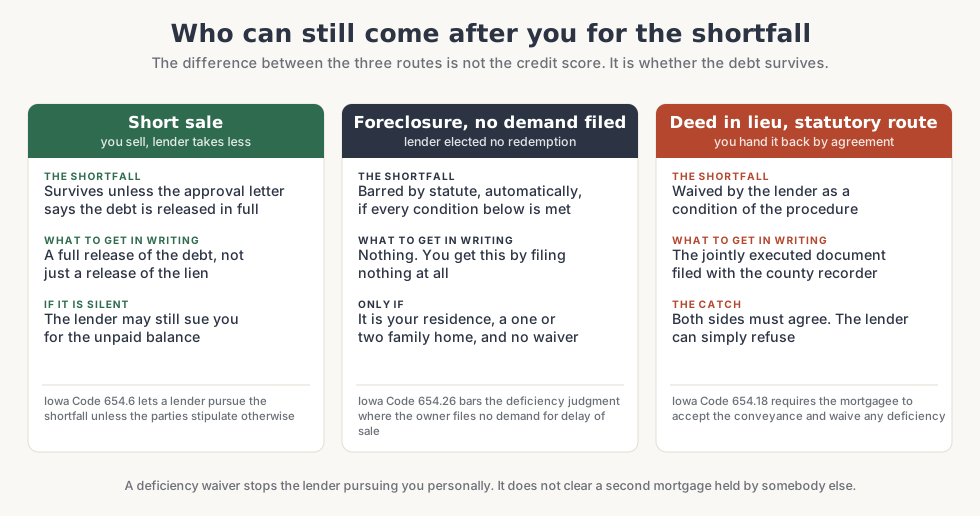
Start with the default rule. Under Iowa Code section 654.6, if the mortgaged property does not sell for enough to satisfy the execution, a general execution may be issued against the mortgagor, unless the parties have stipulated otherwise. Read that last clause twice. The lender's right to pursue you is the default, and it goes away only by agreement or by another statute taking it away.
That is precisely why a short sale is riskier than its reputation. In a short sale the lender agrees to release the lien so the house can be sold. Releasing the lien is not the same as releasing you. Unless the approval letter says the debt is satisfied in full, section 654.6 leaves the balance sitting there.
Now the counter-intuitive part.
Under section 654.26, if the lender elected foreclosure without redemption and did not include a waiver of deficiency judgment in the petition, and the property is your residence and is a one-family or two-family dwelling, and you do not file a demand for delay of sale under section 654.21, then the lender shall not be entitled to a deficiency judgment under section 654.6.
Four conditions, all of which have to hold. But when they do, the protection arrives automatically, and the way you claim it is to file nothing.
You will not learn this by accident. The notice the lender must print on the first page of the petition, set out in section 654.20, spells the trade out in capital letters: file a written demand and the sale is delayed six months from judgment, three if the petition waived a deficiency, but a deficiency judgment may then be entered against you if the proceeds fall short. File nothing and the sale happens promptly, and on those facts no deficiency judgment is entered.
So the choice at that moment is months in the house against personal liability for the gap. Section 654.21 sets those periods, and it also gives you an exit at any point: pay the amount claimed before judgment and the action shall be dismissed, or pay the judgment before the sale and the sale shall not be held. Our walk through the Iowa foreclosure process covers where that decision falls in the sequence.
There is a third route people forget. Under section 654.18, you and the lender can agree a voluntary foreclosure: you convey the property, and the lender shall accept the conveyance and waive any rights to a deficiency or other claim arising from the mortgage. The waiver is not a favour you negotiate, it is built into the procedure. The catch is that both sides must agree, and the lender can simply say no.
What a short sale actually requires
Three things have to line up, and any one of them can sink it.
A buyer willing to wait. Your buyer is not really buying from you, they are waiting on a committee at a servicer. That wait is why short sales fall apart: a buyer with a rate lock and a lease ending will walk.
A lender that says yes. The lender is comparing your offer to what it expects at a sheriff's sale, net of the months and the legal costs. If your offer is close to that number, it usually approves. If it is well below, it usually does not.
Every lienholder saying yes. This is the one that catches people. A second mortgage, a home equity line, a judgment lien, unpaid HOA dues: each has to release for the sale to close, and the second lienholder is often getting little or nothing. One holdout ends it.
If there is a second mortgage, deal with it first. Otherwise you can spend four months on a first-lender approval that a second lienholder kills in a week.
The tax rule changed on 1 January 2026
This is the part that has not filtered through, and it can turn a "responsible" short sale into a five-figure tax bill.
When a lender forgives debt, the forgiven amount is generally taxable income to you. IRS Topic no. 431 states the general rule plainly: if your debt is canceled, forgiven, or discharged for less than the amount owed, the amount of the canceled debt is taxable, and you report it for the year the cancellation occurred. The lender reports it to the IRS on a Form 1099-C.
For years there was an exclusion that made this a non-issue for most homeowners: cancelled debt on your main home was excluded from income. That exclusion has expired. IRS Publication 4681 states in its What's New section that qualified principal residence indebtedness cannot be excluded from income for discharges completed, or discharge agreements entered into, after 31 December 2025.
Forgive $40,000 of mortgage debt in 2026 and, unless something else applies, that is $40,000 of ordinary income on your return, in a year you were broke enough to need a short sale.
It flows through to your state return too. Iowa net income starts from your federal taxable income under Iowa Code section 422.7, and for tax years from 2020 Iowa defines the Internal Revenue Code as amended and in effect, under section 422.3(5)(b). There is no separate Iowa shelter waiting to catch you.
Two exclusions do survive, and this is where a good tax adviser earns their fee. Publication 4681 keeps the exclusion for debt cancelled in a title 11 bankruptcy case, and the exclusion for cancellation to the extent you are insolvent immediately before it, meaning your total liabilities exceeded the fair market value of your total assets. Insolvency is worked out on a worksheet in Publication 4681 and claimed on Form 982. Many people facing a short sale genuinely are insolvent, so this is not an exotic argument, but it is one you have to make with figures.
Watch the ordering, because it is the practical trap. Insolvency is measured immediately before the cancellation. Cancel the debt at a moment when you have just received other money, and the shelter shrinks.
The same rules apply to a foreclosure, so this is not a reason to prefer one route over the other. It is a reason to find out the number before you sign, and to ask whether the timing of the discharge can be moved. General information, not tax advice: talk to an accountant before you agree anything.
The credit question everyone leads with
We have left this last because it is the least decisive, and because we cannot verify the numbers you will see elsewhere.
Every comparison page quotes precise point ranges: a short sale costs you this many points, a foreclosure that many. Those figures come from scoring models whose published documentation we could not confirm from a primary source, and the honest position is that the hit depends on your score before the event and on what else is on the file. Someone at 780 who has never missed a payment falls further than someone at 600 who has missed six payments.
Two things can be said without inventing a number. Both events reach your credit file, and the missed payments that precede either one are already reaching it now. And future lender guidelines set waiting periods that differ by loan programme, which is a real advantage for the short sale, but those guidelines are published by Fannie Mae, the FHA and the VA rather than by us, and their handbooks were not reachable when we checked. Ask a mortgage broker for the current waiting period for the programme you would actually use. Do not plan around a number from a blog.
Where Des Moines actually sits
Whether you are underwater at all is mostly a question of when you bought. We have ingested the Polk County assessor's records: 70,169 Des Moines residential parcels with a readable deed date and an assessment above $10,000.
| When they last changed hands | Share of houses | Average assessment |
|---|---|---|
| 2022 or later | 33.4% | $229,085 |
| 2019 to 2021 | 18.1% | $231,202 |
| 2014 to 2018 | 17.6% | $233,958 |
| 2013 or earlier | 30.9% | $232,357 |
A third of the city's houses last changed hands in 2022 or later. Those are the households with the least equity built up and the highest chance that a payoff plus selling costs lands above what the house fetches. The 30.9% who have been in place since 2013 or earlier are usually in the opposite position, and that changes the advice completely: if you have equity, neither of these routes is your problem. Sell normally, clear the loan, keep the difference. What your house is worth is the place to start, and our how it works page explains what a cash offer does and does not do.
Note these are assessments, not sale prices, and assessment lags the market.
So which one
Push for the statutory deed in lieu if the lender will agree. Under section 654.18 the deficiency waiver is a condition of the procedure rather than something you have to extract. It is the cleanest exit available in Iowa, and it is the one fewest people ask for.
A short sale suits you if you have a buyer who will wait, no second lienholder to satisfy, and, above all, a lender that will put a full release of the debt in writing. Get that release in the approval letter before you accept an offer, not after.
Letting the foreclosure run is rational if the lender elected foreclosure without redemption, did not waive a deficiency, and the house is your one or two family residence. On those facts section 654.26 bars the deficiency if you file no demand. That is a better outcome than most short sales deliver, and it costs you nothing to obtain.
What none of this changes is the tax position. Whichever route ends with debt forgiven, the forgiven amount is now taxable unless bankruptcy or insolvency covers it.
Free help exists, and use it before you call anyone selling something, including us. Iowa Legal Aid takes housing cases for people who qualify on income, and the Iowa Finance Authority funds housing counselling across the state. A counsellor will read your actual approval letter, which is worth more than any article.
Where we fit, honestly
Not here, mostly. A cash sale only helps when the price clears the payoff, and if you are considering a short sale it usually does not. We cannot make a lender release a lien, and we get no special treatment from a servicer.
Where we can help is the case next door to this one: you have some equity, the arrears are growing, and a listed sale would take longer than you have. Then a cash sale converts equity into money before fees and a sheriff's sale eat it. That nets less than listing, always. Our questions we get asked covers the trade in detail, and if any buyer promises to stop a foreclosure or make a deficiency disappear, read our checks worth running before you sign with a cash buyer first. Nobody can promise that.
Frequently asked questions
Does a short sale wipe out what I owe? Not by itself. It releases the lien so the house can be sold. Under section 654.6 the lender keeps the right to pursue the shortfall unless the parties stipulate otherwise, so the release of the debt has to be written into the approval.
Can the lender refuse a short sale? Yes, and it does not have to explain itself. It is comparing your offer with what it expects to net at a sheriff's sale.
Do I owe tax if the lender writes off the difference? Usually yes, from 2026 onwards, per Topic no. 431 and Publication 4681. The main-residence exclusion no longer applies to discharges after 31 December 2025. Bankruptcy and insolvency remain.
Is a deed in lieu the same as a short sale? No. In a short sale the house is sold to a third party. In the section 654.18 procedure you convey it to the lender, which must waive any deficiency and must give you a "Disclosure and Notice of Cancellation" in ten point boldface type.
I already filed a demand for delay of sale. Have I lost the protection? On the facts in section 654.26 the bar depends on not having filed one. Section 654.21 does let you and the lender file a stipulation afterwards that the sale may be held promptly and the lender waives its right to a deficiency judgment. That is a conversation to have with a lawyer quickly.
Last verified 4 September 2026 against Iowa Code section 654.6, 654.18, 654.20, 654.21, 654.26, 422.3 and 422.7, and IRS Topic no. 431, Publication 4681 and Form 1099-C. This is general information, not legal or tax advice.
Wondering what your house is worth?
Polk County publishes an assessed value for every property in Des Moines. Type your address and see yours on screen. No sign-up, and nothing to give us.
Look up my house value