The Iowa Foreclosure Process, Step by Step
Iowa gives you months, not days. The federal 120 days, then thirty to cure, then court. Plus the one form that buys you six more months and can hand the lender back its right to bill you for the shortfall.

Selling an Inherited House in Iowa: Probate, Taxes and Your Options
If your lender has started foreclosing, the most useful thing to know is that Iowa gives you months, not days, and the number depends on choices you make in writing. Some are counter-intuitive: filing a demand to delay your own sheriff's sale buys time and can expose you to a bill for the shortfall. Nobody tells homeowners that, so it is the middle of this page.
We buy houses for cash in the Des Moines metro, so read this knowing we have an interest. Selling to a buyer like us nets less than a listed sale, and for most people here it is the wrong answer. What follows is the process, with the statutes.
The short answer
Your servicer cannot file until you are more than 120 days behind, under 12 CFR 1024.41(f). Before it starts, your lender must send a notice of right to cure and give you thirty days to fix the default, under section 654.2D. Then a court case, a sheriff's sale, and in most cases a redemption period during which you keep possession.
So you almost certainly have longer than you think. And the clock differs by household: redemption after the sale can be a year, six months, three, two, sixty days, thirty or nothing, depending on what the lender elected, whether you file one piece of paper, and whether you still live there.
Find the last thing that happened to you:
| What you have received | Where that puts you |
|---|---|
| Late notices and calls only | Pre-foreclosure, nothing legal started |
| A notice of right to cure | The thirty-day clock under 654.2D is running |
| A petition and original notice | The court case has begun |
| A judgment of foreclosure | Sale is coming, see step three |
| A sheriff's sale notice | Sale scheduled, at least twenty days out |
The rest of this page walks those rows in order.
Step one: the arrears, then thirty days to cure
Iowa law sets no number of missed payments; the federal servicing rule does. Under 12 CFR 1024.41(f), a servicer must not make the first notice or filing for a judicial or non-judicial foreclosure unless your loan is more than 120 days delinquent, with narrow exceptions for a due-on-sale breach or joining another lienholder's action. That is your first four months, and the window in which a modification or repayment plan is likeliest to work, because the servicer has not yet spent money on lawyers.
Then comes the step most people miss, and it is a real protection.
Under section 654.2D, a creditor who believes in good faith you are in default on a mortgage on your homestead must give you a notice of right to cure before starting an action under chapter 654 or the chapter 655A procedure. You then have thirty days from the date the notice is given to cure.
During those thirty days the creditor cannot accelerate the loan, demand possession, or otherwise enforce the debt. And curing does not merely delay matters: under 654.2D(5) it restores your rights under the mortgage. You pay the lesser of all unpaid instalments due when you tender, without acceleration, or the amount stated in the notice. The arrears, not the whole loan.
Two limits. Under 654.2D(7) there is no right to cure if the creditor already gave you a proper cure notice for an earlier default within the previous 365 days. Under 654.2D(8) it does not apply if your creditor is an individual, or the property is not a one or two family dwelling that is your residence. The notice has required contents under section 654.2B, including the date you must pay by, but a defective notice is not a defence unless you prove you were substantially prejudiced.
After the cure period, section 654.4B adds two steps for an owner-occupied one or two family home: a fourteen-day demand for the accelerated balance, and a notice that counselling and mediation are available. If that notice was never served and you want counselling, the court shall delay the sale or the recording of the deed by up to sixty days.
Step two: which kind of foreclosure this is
Iowa does have a nonjudicial procedure in chapter 655A. But section 655A.9 says it does not apply to a one or two family dwelling occupied by a legal or equitable titleholder when the foreclosure is initiated, nor to agricultural land.
So if you live in your house, the nonjudicial route is not available against you and your foreclosure goes through court. Read that as good news: a judge, a docket, and deadlines you can see.
Chapter 655A does apply to a rental or vacant property, and it is fast. The mortgagee serves a notice under section 655A.3 stating that unless within thirty days you either perform the terms in default or file a rejection with the county recorder and serve a copy on the mortgagee, the mortgage will be foreclosed. Miss both and the foreclosure is simply complete: you lose title, with no sheriff's sale and no redemption, though the debt secured by the property is extinguished. Filing that rejection under section 655A.6 voids the notice and pushes the lender into court. If you own a Des Moines rental and one arrives, those thirty days are the whole ballgame.
There is also a voluntary route in section 654.18: you convey the property and the lender waives any deficiency. It requires a "Disclosure and Notice of Cancellation" in ten point boldface type stating that you are giving up your right to reclaim and occupy the property.
Step three: judgment, and the one form that changes everything
When the court forecloses, section 654.5 requires judgment for the whole amount due and an order to sell. Before that judgment, one election by the lender and one response by you decide both your timeline and your exposure.
Under section 654.20, on a non-agricultural property the lender may elect foreclosure without redemption. Then the first page of the petition must carry a notice in capital letters saying the sale will happen promptly after judgment unless you file a written demand to delay it, and that you will have no right of redemption afterwards.
If you file that demand, section 654.21 sets when the sale happens:
| Your situation | Sale held after |
|---|---|
| Demand filed, your residence, one or two family dwelling | six months from judgment |
| Same, but the petition waives a deficiency judgment | three months from judgment |
| Demand filed, any other property | two months from judgment |
| No demand filed | promptly after judgment |
Now the part almost nobody explains. Read section 654.26 alongside it. Where the lender elected foreclosure without redemption and did not waive a deficiency, and the property is your one or two family residence, then if you do not file a demand for delay of sale, it is not entitled to a deficiency judgment. File the demand and, per the notice in 654.20(2), one may be entered if the proceeds fall short.
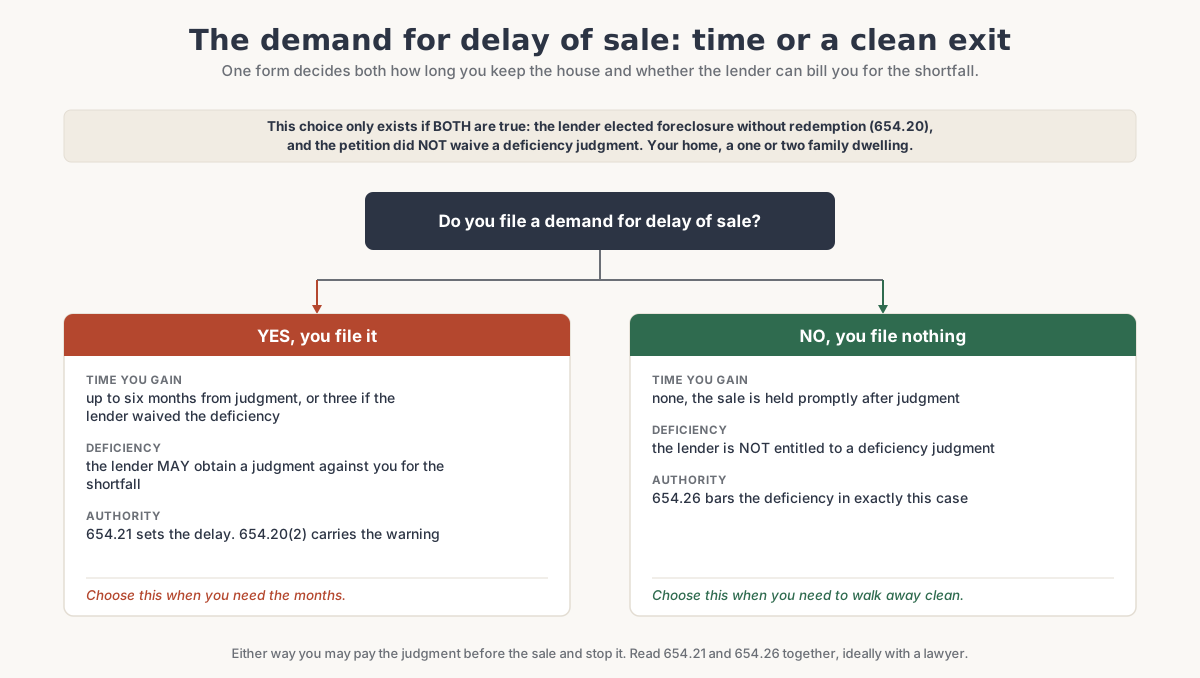
The trade, on an owner-occupied house where the lender elected foreclosure without redemption and did not waive the deficiency.
File the demand for delay of sale: you stay up to six months longer, exposed to a personal judgment for the shortfall.
File nothing: the sale happens promptly, but under section 654.26 the lender cannot come after you for the difference.
Which is right depends on whether you need time or a clean exit. It is worth a lawyer's hour.
Before judgment you can pay the amount claimed in the petition and the action is dismissed. After judgment and before the sale you can pay the judgment, and no sale is held. Section 654.21 again.
Step four: the sheriff's sale
If you still occupy any part of the property, the sheriff must serve written notice at least twenty days beforehand, with the time and place, under section 626.78. A sale held without it can be set aside on a motion within ninety days, under section 626.79.
It is also posted in three public places in the county, one at the courthouse, plus two weekly newspaper publications, the first at least four weeks out, under section 626.75. That is why a Polk County foreclosure becomes public a month before the auction.
The sale is a public auction between 9:00 a.m. and 4:00 p.m., and the sheriff also takes sealed written bids beforehand, under section 626.80. You may bid. With no bidders, or an offer that is grossly inadequate, the sale can be postponed, but not more than two adjournments totalling sixty days without written agreement, under section 626.81.
If your house is worth more than the debt, this matters: under section 626.82, where the property sells for more than the amount required to be collected, the surplus must be paid to you unless other liens claim it. Equity is a poor thing to realise this way, but it is not forfeited.
Step five: redemption, and how long you keep the house
Unless the lender elected foreclosure without redemption, there is a redemption period after the sale and you are entitled to possession during it.
The general rule in section 628.3 is one year from the day of sale, the first six months exclusive to you, and property you redeem is free of any unpaid part of the judgment. That year is frequently shortened, usually by your mortgage or the court's findings:
| Situation | Redemption period | Authority |
|---|---|---|
| General rule | one year, first six months exclusive | 628.3 |
| Under ten acres, agreed reduction, deficiency waived | six months, or three if not agricultural | 628.26 |
| Court finds it abandoned, deficiency waived | sixty days, first thirty exclusive | 628.27 |
| Not your residence, or not a one or two family dwelling | 180 days, or ninety if deficiency waived | 628.28(1) |
| Was your residence, but the court finds you moved out | thirty days from the order, sixty if a junior creditor | 628.28(2) |
| Lender elected foreclosure without redemption | none | 654.20 |
The last two rows are the practical trap: moving out early can cut a redemption period you were entitled to. Under section 628.28(2), if the court finds the dwelling ceased to be your residence after foreclosure and there are no junior creditors, it shall reduce redemption to thirty days from the order. If you have a redemption period and want it, live in the house.
Two mechanics. Redeeming means paying into the clerk's office the certificate of sale amount plus the sums and interest set out in section 628.13, not just your arrears. And under section 628.4, a party who has stayed execution on the judgment cannot redeem.
Where selling fits, and where it does not
You can sell at any point before the sheriff's sale, and afterwards you can sell your right of redemption. Whether you should turns on your equity.
We have ingested the Polk County assessor's records, 183,474 parcels. For the 71,519 Des Moines residential parcels with a recorded deed date, ownership length splits like this.
| Bought | Houses | Share | Median assessment |
|---|---|---|---|
| In the last 3 years | 16,124 | 22.5% | $190,400 |
| 3 to 5 years ago | 10,064 | 14.1% | $190,800 |
| 5 to 10 years ago | 17,924 | 25.1% | $199,700 |
| More than 10 years ago | 27,407 | 38.3% | $195,700 |
The median assessment barely moves across those rows, $190,400 to $199,700, so the houses are much the same. What differs is how much of them the owner has paid for. 38.3% have been owned more than ten years, usually well into a mortgage that was smaller to begin with. 22.5% changed hands in the last three years, at higher prices, with barely any principal paid down. That divide decides your options, not the house.
Owned it a long time, so you likely have equity? Protect it. That usually means listing, using the cure right and redemption period as the time to do it. Start with our guide to what your house is worth, and if it needs work, what repairs actually earn back.
Bought recently? Arrears plus fees plus selling costs may be close to or above what the house will fetch. Then the questions are a short sale, a deed in lieu under section 654.18, or letting the sale happen with the deficiency waived. We compare those routes, and who can still chase the shortfall after each, in short sale vs foreclosure. A cash sale usually does not help, because we cannot clear the loan either.
A cash sale is useful in a narrow case: you have equity, a sale must complete by a specific date, and the house will not survive a lender's appraisal or a sixty day listing. Our how it works page sets out the process and the questions we get asked most covers the rest. The limits, plainly: we pay less than the open market, cannot stop a foreclosure by ourselves, and if you have equity and time an agent will very likely beat us. The options to stop it that do not involve selling are worth reading first. If anyone, us included, proposes that you sell but stay in the house, that is a regulated transaction, and the checks to run before signing sets out chapter 714F.
Free help that is not us
Iowa Legal Aid publishes foreclosure self-help materials and screens for free representation. The Iowa Finance Authority runs a mortgage help programme for homeowners in default, and HUD approves counselling agencies statewide. The notice required by section 654.4B exists so you find them.
Farmland is a different regime: chapter 654A makes mediation a prerequisite to foreclosing on agricultural property, and the cure period under section 654.2A is forty-five days. Farm-only, not a house in Des Moines.
Frequently asked questions
Is Iowa a judicial or nonjudicial foreclosure state? Both exist, but for a house you live in it is judicial: section 655A.9 excludes an owner-occupied one or two family dwelling from the nonjudicial chapter.
How many payments can I miss before foreclosure? Iowa sets no number. 12 CFR 1024.41(f) stops your servicer filing until you are more than 120 days delinquent, and section 654.2D adds thirty days.
Do I have to move out when the sheriff sells the house? Not if there is a redemption period: under section 628.3 you are entitled to possession during it. Where the lender elected foreclosure without redemption, the purchaser gets immediate possession.
Can the lender still come after me for the shortfall? Sometimes. Section 654.6 allows a general execution where the property does not sell for enough, but section 654.26 bars it in the case above.
Should I move out to save money? Think hard. Moving out can let the court cut your redemption to thirty days under section 628.28(2), or support an abandonment finding reducing it to sixty under section 628.27.
Last verified 31 August 2026 against the primary sources linked above: Iowa Code 654.2A, 654.2B, 654.2D, 654.4B, 654.5, 654.6, 654.18, 654.20, 654.21, 654.26, 654A.6, 655A.3, 655A.6, 655A.9, 626.75, 626.78, 626.79, 626.80, 626.81, 626.82, 628.3, 628.4, 628.13, 628.26, 628.27, 628.28, and 12 CFR 1024.41(f). Parcel figures are from our own ingest of the Polk County assessor's records. This is general information about Iowa law, not legal or tax advice, and foreclosure outcomes turn on your specific documents. If you are facing a sheriff's sale, speak to a lawyer or Iowa Legal Aid.
Wondering what your house is worth?
Polk County publishes an assessed value for every property in Des Moines. Type your address and see yours on screen. No sign-up, and nothing to give us.
Look up my house valueMore on inherited property

The Iowa Small Estate Affidavit Will Not Transfer a House. Here Is What Does
Iowa's small estate affidavit covers up to $100,000 of personal property as of July 2026, but it cannot transfer real estate at all. If the estate includes a house, the route you want is chapter 635 small estate administration, and its ceiling is $200,000.

How Long Does Probate Take in Iowa? Six Months Is the Floor
Iowa probate runs six to twelve months, and the reason for the floor is a four month creditor claim window set by statute. But you do not have to wait for the estate to close to sell the house, and most families should not.