How to Sell Your House Fast: Every Route, Honestly
Fast is a dial, and every notch costs money. On a median Des Moines house the gap between the quickest sale and the most patient one is about $19,800, which is roughly four years of carrying costs.
Selling an Inherited House in Iowa: Probate, Taxes and Your Options
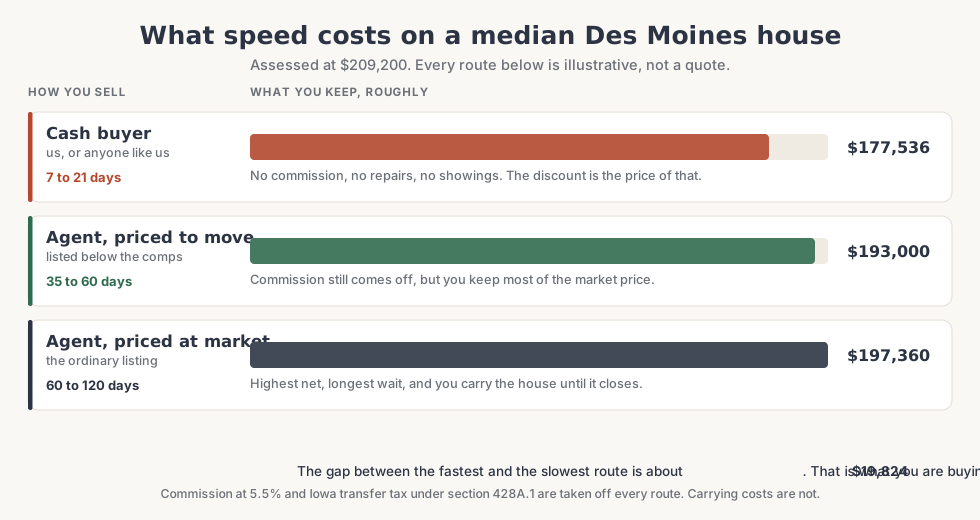
Fast is not one thing. It is a dial, and every notch you turn it costs money. So before the tactics, the number that actually decides this: on a median Des Moines house, the gap between the quickest sale and the most patient one is roughly $19,800.
That is the honest frame. We buy houses for cash in the Des Moines metro, which means we are the fastest and most expensive option on this page. Most people reading this should not sell to us. Here is how to work out whether you are one of them.
The answer, up front
There are three real routes for an ordinary house in Polk County, and they differ by weeks and by thousands.
| Cash buyer | Agent, priced to move | Agent, priced at market | |
|---|---|---|---|
| Time to close | 7 to 21 days | 35 to 60 days | 60 to 120 days |
| Commission | None | Yes | Yes |
| Repairs expected | None | Some | Usually |
| Showings | One visit | Yes | Yes |
| Certainty | High | Medium | Medium |
| What you keep | Least | Close to most | Most |
The middle column is the one almost nobody talks about, and it is where most people who need speed should land. An agent pricing deliberately under the comps is a fast-sale strategy. It is slower than us and it keeps most of your money.
Work out what you are actually buying
Take the numbers above seriously for a moment, because they change the decision.
The median assessed value of a Des Moines residential parcel is $209,200. That is from the Polk County assessor's records, 84,539 parcels above $10,000. Run the arithmetic on that house:
Sale at $209,200 through an agent. Commission at 5.5% takes $11,506. Iowa's real estate transfer tax takes $334. You net about $197,360 before anything else.
A cash offer at 85% of that price is $177,820, with no commission. After transfer tax you net about $177,536.
The difference is $19,824. These are illustrative figures on an assessed value, not an offer.
Now divide that gap by what the house costs you to hold. Property tax, insurance and utilities on a house at that value run somewhere near $370 a month. The $19,824 you gave up buys roughly four years of carrying costs.
That is the test. If waiting sixty days costs you two months of carry, waiting is obviously right. If waiting sixty days costs you a foreclosure sale, a second mortgage payment on a house you have already left, or a job you cannot start, the maths flips. Speed is worth paying for when the delay itself is expensive, and not otherwise.
Iowa's transfer tax, so you can budget it
Under Iowa Code section 428A.1, the tax is eighty cents for each $500, or fraction of $500, of the sale price above the first $500. There is no tax where there is no consideration.
| Sale price | Transfer tax |
|---|---|
| $150,000 | $239.20 |
| $209,200 | $334.40 |
| $250,000 | $399.20 |
| $300,000 | $479.20 |
Small, but it is not optional. The county recorder must refuse to record the deed if the tax has not been paid, under section 428A.4. The same section requires a declaration of value with the deed. Certain transfers are exempt under section 428A.2, including deeds between parent and child without actual consideration, and mortgages.
The disclosure you cannot skip, and the one that is new this year
Speed tempts people to skip paperwork. Two pieces are not skippable, and one of them changed in January.
Iowa requires a written disclosure statement about the property's condition for most sales of one to four dwelling units. Under section 558A.2, you must deliver it before you make or accept a written offer. Miss that timing and the buyer may withdraw the offer or revoke their acceptance without liability, within three days of personal delivery or five days of post or electronic delivery. That is a hole in your certainty, and it opens after you think you have a deal.
The new part. Section 558A.4 now requires the disclosure to cover the presence of lead service lines. That requirement came from a 2025 act and took effect on 1 January 2026. Section 558A.1 defines a lead service line, and treats a galvanised line as one if it ever sat downstream of a lead line or a line of unknown material. In older parts of Des Moines this is a real question, not a form-filling exercise.
Everything in the disclosure must be given in good faith, and section 558A.3 lets you use a clearly identified approximation where you have made a reasonable effort and still do not know. You must amend the statement if what you said becomes inaccurate or misleading. Guessing to save a day is how a fast sale turns into a lawsuit.
Second, the groundwater hazard statement. Section 558.69 requires a statement covering private burial sites, wells, solid waste disposal sites, underground storage tanks, hazardous waste and private sewage systems. If none of those exist, you instead put the prescribed sentence on the first page of the deed. Either way, the recorder must refuse to record without it. The owner is responsible for the accuracy.
Who is exempt. Some transfers fall outside the condition disclosure entirely under section 558A.1: transfers by court order, foreclosures under chapter 654, transfers to a mortgagee by an owner in default, transfers between joint tenants, transfers by quitclaim deed, and transfers by a fiduciary administering an estate. That last one has a catch worth knowing if you are selling a parent's house: the exemption does not apply where the fiduciary is a living person who occupied the property at any time in the twelve months before the transfer.
The tax trap of selling quickly
This is the part that costs real money and almost never appears in a "sell fast" guide, because it depends on something a national page cannot know: how long you have owned the house.
If you sell your main home at a gain, you may exclude up to $250,000 of that gain, or $500,000 filing jointly. But IRS Topic no. 701 sets two tests you must both meet: you owned the home for at least 24 months of the five years before the sale, and you lived in it as your residence for at least 24 months of those five years. Publication 523 has the full rules.
Here is why that matters in this city. Of Des Moines residential parcels with a readable deed date, 15.7% last changed hands within the past 24 months.
| When it last changed hands | Share of houses |
|---|---|
| Within the last 24 months | 15.7% |
| Two to five years ago | 20.5% |
| More than five years ago | 63.8% |
If you are in that first band and you sell in a hurry, you may fail the ownership and use test and owe tax on a gain you assumed was exempt. And a house held one year or less is a short-term gain, taxed as ordinary income rather than at the lower long-term rates, per IRS Topic no. 409.
There are exceptions, including a partial exclusion in some circumstances and a suspension of the five-year period for certain service members. Those are in Publication 523. If you bought recently, work out the tax before you accept any offer, including ours. Waiting three months for the clock can be worth more than the entire speed premium. General information, not tax advice: ask an accountant.
What actually makes a sale fast
Strip out the staging advice. Four things decide speed, and only two are in your control.
Price. Nothing else comes close. A house priced under its comps sells quickly on the open market, and that is the middle column of the table: a fast sale that still pays a commission and still keeps most of your money.
The buyer's money. A cash buyer removes the lender, and the lender is where weeks go: underwriting, appraisal, conditions. This is the whole of our speed advantage. It is not cleverness, it is the absence of a mortgage.
Title. This is the one that surprises people. An unreleased old mortgage, a lien from a contractor, an heir who never signed, a boundary problem: any of these stops a closing dead, and none of them care how motivated you are. Nobody can fix a title defect quickly. If you are in a genuine hurry, get a title search started on day one rather than day thirty.
Condition, but only at the edges. A house needing work does not sell slowly on the open market so much as it sells to a smaller pool. Our post on selling a house that needs repairs covers where that line falls and when repairs pay for themselves.
What does not make a sale fast
Skipping the disclosure. Accepting an offer with a financing contingency and hoping. Choosing the highest number on the table without asking where the money is. Signing with anyone who will not show proof of funds.
A high offer from a buyer who cannot close is slower than a lower offer that closes, because you lose the weeks and then start again with a house that now looks stale. Ask for proof of funds, ask who is on the deed at closing, and ask whether the contract can be assigned to somebody else. Our list of checks worth running before you sign with a cash buyer goes through this properly, including the rules that apply if you are behind on payments.
Nobody needs a licence to buy your house
Worth knowing before you take a call. Under Iowa Code section 543B.7, the real estate licensing chapter does not apply to a person buying or selling property they own or are acquiring, provided they are not making repeated and successive transactions of a like character. So the person offering to buy your house is very likely not licensed, not bound by an agent's duties to you, and not regulated by the real estate commission. That is true of us as well.
It is not a scandal. It does mean the protections you might assume are there are not, so your own checks have to do that work.
Where we fit, plainly
We are the right answer in a narrow set of cases: the house needs more work than you can fund, the timeline is set by something outside your control, the property has a complication that scares off ordinary buyers, or you simply value the certainty more than the $19,800.
We are the wrong answer if you have time. If nothing is forcing your hand, list it. You will net more, and it is not a close call. If you want that gap itemised rather than summarised, what a cash offer really nets takes every deduction line by line.
If you want the number for your own house rather than a median, what your house is worth is the place to start, how it works sets out our process without the sales gloss, and the questions we get asked covers the trade in more detail.
Frequently asked questions
How fast can a cash sale really close? Seven to twenty-one days is realistic once title is clear. Title is the variable, not the buyer.
Do I pay commission on a cash sale? Not to us, because there is no agent. That saving is already inside the discount, so do not count it twice.
Will I owe tax if I sell quickly? Possibly. The main-home exclusion needs 24 months of ownership and 24 months of use within the last five years, per Topic no. 701, and a house held a year or less is taxed as a short-term gain under Topic no. 409.
Can I sell fast with a mortgage still on it? Yes. The loan is paid off at closing out of the proceeds. It only becomes a problem if the payoff is more than the sale price, which is a different situation entirely, covered in short sale vs foreclosure.
Do I still have to fill in the disclosure for a cash sale? Yes, unless your transfer is one of the exempt categories in section 558A.1. A buyer paying cash does not remove the duty, and section 558A.2 requires delivery before an offer is made or accepted.
What if the house is in foreclosure? Different rules apply on top of these, and there may be more time than the letters suggest. Start with the Iowa foreclosure process.
The short version
Speed costs about $19,800 on a median Des Moines house, which is roughly four years of carrying costs, so it is worth paying only when the delay is itself expensive. Price is what makes a sale fast on the open market and title is what makes it slow. Deliver the disclosure before you accept an offer, and remember it now has to cover lead service lines. If you bought within the last two years, check the tax position before you sign anything.
Last verified 7 September 2026 against Iowa Code section 428A.1, 428A.2, 428A.4, 543B.7, 558.69, 558A.1, 558A.2, 558A.3 and 558A.4, and IRS Topic no. 701, Topic no. 409 and Publication 523. Assessed values are from the Polk County assessor and lag the market. This is general information, not legal or tax advice.
Wondering what your house is worth?
Polk County publishes an assessed value for every property in Des Moines. Type your address and see yours on screen. No sign-up, and nothing to give us.
Look up my house valueMore on inherited property

The Iowa Small Estate Affidavit Will Not Transfer a House. Here Is What Does
Iowa's small estate affidavit covers up to $100,000 of personal property as of July 2026, but it cannot transfer real estate at all. If the estate includes a house, the route you want is chapter 635 small estate administration, and its ceiling is $200,000.

How Long Does Probate Take in Iowa? Six Months Is the Floor
Iowa probate runs six to twelve months, and the reason for the floor is a four month creditor claim window set by statute. But you do not have to wait for the estate to close to sell the house, and most families should not.