Transfer on Death Deeds in Iowa: What They Do and Do Not Solve
Iowa has no transfer on death deed for real property, whatever the top search results tell you. Here are the three instruments that do keep a house out of probate here, what each one costs you, and the tax trap in the cheapest of them.
Selling an Inherited House in Iowa: Probate, Taxes and Your Options
If you are looking for an Iowa transfer on death deed, here is the answer before anything else.
Iowa does not have one. There is no deed you can sign and record that hands your house to a named person when you die. Every state bordering Iowa has that instrument. Iowa does not, and the bill to create one has sat in House Judiciary since January 2025.
This matters because much of what is written about Iowa estates says the opposite. One page currently ranking for this exact search tells you an Iowa TOD deed "must comply with Iowa Code Chapter 633F" and walks you through recording it. Chapter 633F is the Iowa Uniform Custodial Trust Act and has nothing to do with deeds. Follow that and you will pay to record a document that does not do what you think, and nobody will find out until your children are in probate, selling the house through the court.
So this page covers what Iowa actually has: the three instruments that genuinely keep a house out of probate, what each costs you in control and in tax, and the one that quietly costs your heirs the most.
Why people expect a TOD deed to exist
The instrument is real. You record it while you are alive, it conveys nothing during your lifetime, you can revoke it whenever you like, and on your death the property passes to the named beneficiary without probate.
It spread through the states as the Uniform Real Property Transfer on Death Act. Minnesota, Missouri, Illinois, Nebraska, Wisconsin and South Dakota all have it. If you moved to Des Moines from any of those states, or a sibling in Omaha has told you what they did with their house, you have every reason to assume Iowa is the same.
It is not. The confusion is worse because Iowa does use transfer on death registration for other kinds of property, which is where the half-truths come from.
What Iowa does allow to pass on death
Iowa's transfer on death statute is chapter 633D, the Transfer on Death Security Registration Act. Read the title carefully: it is about securities.
It covers shares, bonds, brokerage accounts, the cash balance in those accounts, and investment or custody accounts at a bank. Register the account in beneficiary form and it passes on your death without probate, at no cost.
It does not reach real estate, and that is not an oversight in the drafting. A house is a public title record, and the next buyer's title insurer has to be satisfied that ownership passed properly. A registration form held by a broker cannot do that job.
Vehicles are a third case, often stated wrongly. Iowa has no beneficiary registration for a car either. Section 321.47 instead lets the people entitled under descent and distribution file an affidavit with the county treasurer and get a new title issued: a post-death route, not something you set up in advance.
| Asset | Passes by beneficiary designation in Iowa? |
|---|---|
| Brokerage or investment account | Yes, chapter 633D |
| Bank account | Yes, payable on death |
| Life insurance, retirement account | Yes, named beneficiary |
| Car | No, but section 321.47 gives an affidavit route after death |
| House or land | No. Nothing does this in Iowa. |
The bill that would change it, and where it stands
House File 125 would adopt the Uniform Real Property Transfer on Death Act as a new chapter 633G: revocable deeds, recording required before death, statutory forms, and an express provision that a TOD deed does not affect eligibility for public assistance during life.
Its history is short. Introduced 27 January 2025 by Representative Nordman, subcommittee recommended passage on 6 February 2025, and then nothing: the last entry is 25 February 2025. House File 816 is a related measure from the same General Assembly, and neither has been enacted. The simplest confirmation is the absence of the chapter itself: every enacted chapter of the Iowa Code is published on the legislature's site, and there is no chapter 633G there to read.
The 91st General Assembly runs until January 2027, so HF125 is technically still alive and could move next session. Plan for the law as it is, not as it might become. If it passes, this page will be updated.
The three things that actually work in Iowa
If you want a house to skip probate in Iowa, you have three options. Each one has a real cost, and the cost is not mainly the setup fee.
Joint tenancy with right of survivorship
The cheapest and most common. Under section 557.15, a conveyance to two or more people creates a tenancy in common by default, becoming joint tenancy with survivorship only if the instrument says so: "joint tenants," "joint tenancy," "or their survivor," or grantees identified as married to each other.
That default catches people out. A deed naming you and your son, drawn up without care, may have created a tenancy in common, in which case his share does not pass to you at all. Read the deed.
When it does work, the survivor owns the house the moment the other owner dies. No probate, no filing. The costs are real, though:
- You give away ownership today. A joint tenant is an owner now, not a beneficiary later, so you cannot sell or remortgage without them.
- Their creditors become your problem. A judgment against your son can attach to the house you live in.
- It is not revocable without their signature.
- The tax cost is the big one, and it has its own section below.
A living trust
You create a trust, and then, this is the part people miss, you retitle the house into it with a recorded deed. A trust document that lists the house but was never followed by a deed does not work: the house is still in your name and still going through probate.
Done properly it is the most flexible option: full control, revocable and amendable, and the successor trustee can sell without a court.
One Iowa catch: a revocable trust does not defeat a spouse's elective share. Under section 633.238, that share expressly includes one-third in value of property held in a trust the decedent could alter, amend or revoke at death, and one-third of the real property the decedent possessed at any time during the marriage. A trust set up to route the house around a spouse does not do that, unless the spouse signed a waiver in the specific boldface form the statute lays out.
A life estate deed
You deed the house to your children now but keep the right to live in it for life. On your death the remainder becomes theirs outright, with no probate.
Simple and cheap to record, and the least flexible of the three: you cannot sell or remortgage without the remaindermen agreeing, and you cannot undo it if you fall out or one of them divorces or is sued. It also does not do the thing many people set one up to do, which is next.
The Medicaid point, because it is usually stated wrongly
A lot of estate planning content sells the life estate deed as a way to shield the house from Medicaid estate recovery. In Iowa, read the statute first.
Section 249A.53 defines the estate Medicaid can recover from, and it is drawn deliberately wide: any asset in which the recipient "had any legal title or interest at the time of death, to the extent of such interests, including but not limited to interests in jointly held property, retained life estates, and interests in trusts."
Those are, word for word, the three instruments above. The statute then makes all of them subject to probate for the purpose of collecting that debt.
That does not make planning pointless. Timing and the type of interest matter, and a genuine transfer made well in advance is a different thing from a retained life estate. But if someone tells you a life estate deed puts the house beyond Medicaid's reach in Iowa, ask them to show you how they get there from that sentence.
The tax trap in joint tenancy, which nobody mentions
This is the part that costs real money, and it is almost never in the articles ranking for this search.
When you inherit a house, your basis for capital gains resets to the market value on the date of death, so selling soon after produces very little gain and very little tax. That is the stepped up basis, and the IRS states it in Publication 551: the basis of inherited property is generally the fair market value at the date of death. We cover it, and every other tax an heir meets, separately.
Joint tenancy only gets you part of that. The worked example in the same publication makes it plain. A surviving joint tenant who contributed nothing to the purchase price and had no interest in the income takes the full date-of-death value. But where both owners contributed, the survivor keeps their original cost basis on their own share, and only the deceased owner's share steps up.
Put Iowa numbers on it. Your mother buys a house in Beaverdale for $80,000 in 1996, adds you to the deed as a joint tenant in 2015, and dies this year with the house worth $280,000.
As a joint tenant. You already owned half at her original cost, roughly $40,000. Her half steps up to $140,000. Your basis is about $180,000. You sell for $280,000 and you have a $100,000 gain to report.
As an heir through probate. The whole house steps up to $280,000. You sell for $280,000 and your gain is nil.
The joint tenancy saved a few thousand dollars of probate cost and created a six-figure taxable gain. At a 15 per cent federal capital gains rate that is roughly $15,000, before any Iowa income tax.
That is the trade nobody puts in the brochure. Sometimes probate is the cheaper route, and for a modest Iowa estate it often is, because Iowa has no state estate tax, the inheritance tax was repealed for deaths on or after 1 January 2025, and federal estate tax does not begin until $15,000,000 for a death in 2026. For nearly every family in Polk County there is no death tax at stake at all. The only real cost is the administration, and how long that takes and what it costs is more manageable than most people assume.
Comparing the three
| Joint tenancy | Living trust | Life estate deed | |
|---|---|---|---|
| Avoids probate on the house | Yes | Yes, if retitled | Yes |
| You keep full control | No | Yes | No |
| Revocable by you alone | No | Yes | No |
| Exposed to the other party's creditors | Yes | No | Remainder is |
| Full stepped up basis for the heir | Often not | Yes | Partial |
| In the Medicaid recovery estate | Named in the statute | Named in the statute | Named in the statute |
| Cost to set up | Lowest | Highest | Low |
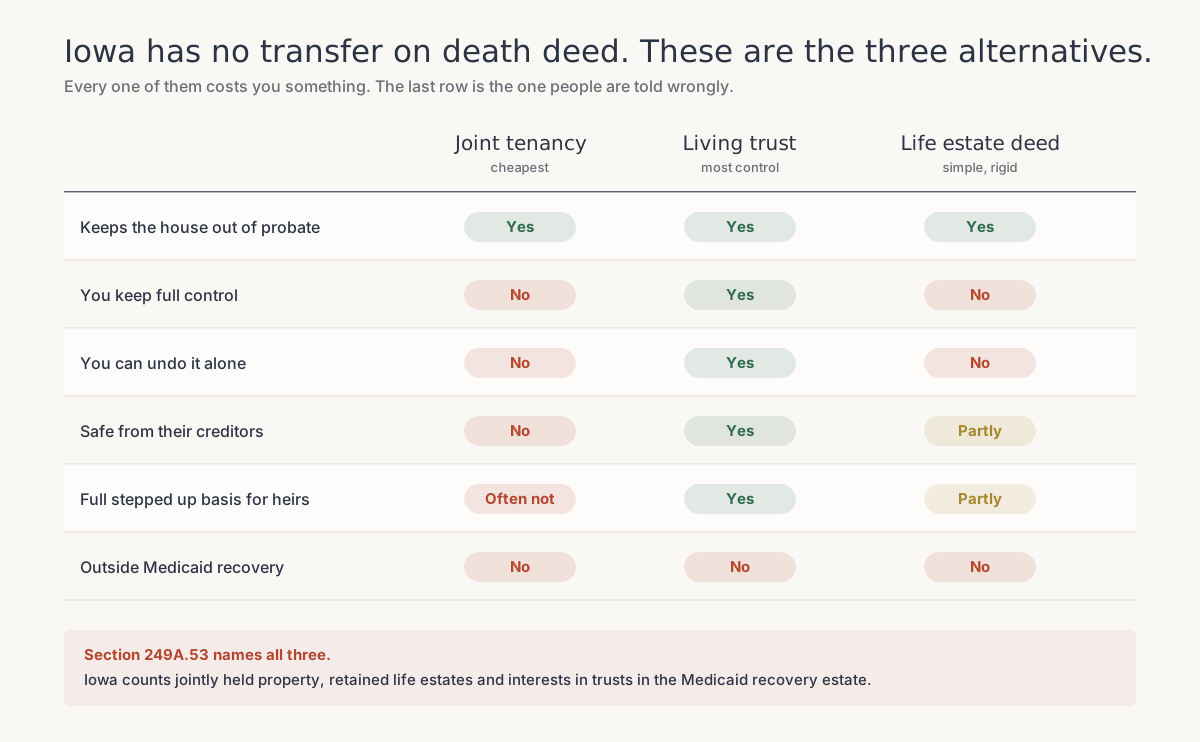
There is no free option in that table. The right answer depends on the size of the estate, whether there is a spouse, whether long-term care is a live prospect, and how large the gain on the house would be. That is a conversation with an Iowa attorney, and it is worth the fee.
What to do if you are reading this after a death
If the person has already died and the house was owned outright in one name, nothing in this article helps retroactively. The house is going through a court process, and anyone who tells you otherwise is selling something.
You can still pick the lighter process. Iowa has a simplified administration under section 635.1 for estates whose probate assets do not exceed $200,000, and it can include real estate. Our guide to the small estate affidavit and the chapter 635 route explains which applies, and why the affidavit itself will never work for a house.
And you do not have to wait for the estate to close before selling. The personal representative can sell with court approval well before the final report, which matters when the house is empty, insured at a vacancy rate, and heating itself through a Des Moines winter for nobody's benefit.
If the house is the problem rather than the plan
Most people who land here are not planning. They have a house in Windsor Heights or on the east side that belonged to a parent, a sibling out of state, and a growing sense the whole thing will take a year.
If that is you, the honest options are a listing or a cash sale, and they are not the same trade. A listed sale gets a higher number, takes longer, and usually needs repairs paid for out of an estate with no cash in it yet. Whether those repairs earn their money back depends on how much of the value is the house rather than the lot, which is the question in selling a house that needs repairs. A cash sale nets less. We will not pretend otherwise, and anyone quoting market value in cash is not being straight with you. What it buys is a date certain and no work: no clearing, no repairs, no showings while probate runs in the background.
Which is right depends on the repair bill, how far apart the heirs live, and whether anyone has time to manage it. To see what the house is worth before deciding, start with the address, or read how our process works.
Common questions
Does Iowa have a transfer on death deed? No. No statute authorises one for real property here. Chapter 633D covers securities and investment accounts only, and HF125 has not passed.
Can I use a TOD deed from another state on my Iowa property? No. Real property is governed by the law of the state where it sits, so a Missouri beneficiary deed does not reach a house in Des Moines.
Can I add a beneficiary to my house deed in Iowa? Not as a beneficiary. You can add a joint tenant with right of survivorship, but that makes them an owner today, with all the consequences above.
Is joint tenancy the same as a TOD deed? No, and the difference is the one that costs money. A TOD beneficiary owns nothing until you die, so the property steps up fully in basis. A joint tenant owns a share from the day they are added, and only the deceased owner's share steps up.
My spouse died and we owned the house jointly. Do I need probate? Generally not for the house, which passes to you by survivorship, though other assets in their sole name may still need a process. A surviving spouse also has the right under section 561.11 to occupy the whole homestead until it is otherwise disposed of according to law.
What is Iowa's small estate limit? Two figures for two different things. The affidavit for personal property is capped at $100,000 and cannot touch real estate. Small estate administration under chapter 635, which can include a house, is capped at $200,000.
Last verified 21 August 2026 against Iowa Code chapter 633D, chapter 633F, section 557.15, section 633.238, section 249A.53, section 321.47, section 561.11, section 635.1, section 450.98, House File 125, House File 816, IRS Publication 551 and the IRS estate tax threshold.
This is general information about Iowa law, not legal or tax advice. Deeds, trusts and Medicaid planning turn on facts specific to you, and the wrong instrument recorded in good faith can be expensive to unwind. Speak to an Iowa attorney before you sign anything.
Wondering what your house is worth?
Polk County publishes an assessed value for every property in Des Moines. Type your address and see yours on screen. No sign-up, and nothing to give us.
Look up my house value