Stopping a Foreclosure in Iowa: Your Options
Most people reading this should keep the house, and the law gives you more ways to do it than the letters suggest. The routes that work, the deadlines that bite, and the narrow case where selling is the right answer.
Selling an Inherited House in Iowa: Probate, Taxes and Your Options
If a foreclosure has started on your house in Des Moines, you almost certainly have more options than the letters suggest, and the best one is usually not selling.
We buy houses for cash, and we are telling you first that most people reading this should keep their house. The routes that stop a foreclosure and leave you in it are written into law, and several cost nothing. Selling is right for a narrow group, and we are specific about who at the end.
The short answer
People mean different things by "stop the foreclosure", and they have different answers.
| What you want | What does it | Deadline |
|---|---|---|
| Stop it before it is filed | Cure the default in the thirty-day window | 30 days from the cure notice |
| Stop the case that is already filed | Loss mitigation with the servicer, or pay the claim | 37 days before sale for the federal rule |
| Stop the sheriff's sale itself | Pay the judgment, file bankruptcy, or apply on a missed notice | Before the sale is held |
| Keep the house after the sale | Redemption | Usually one year |
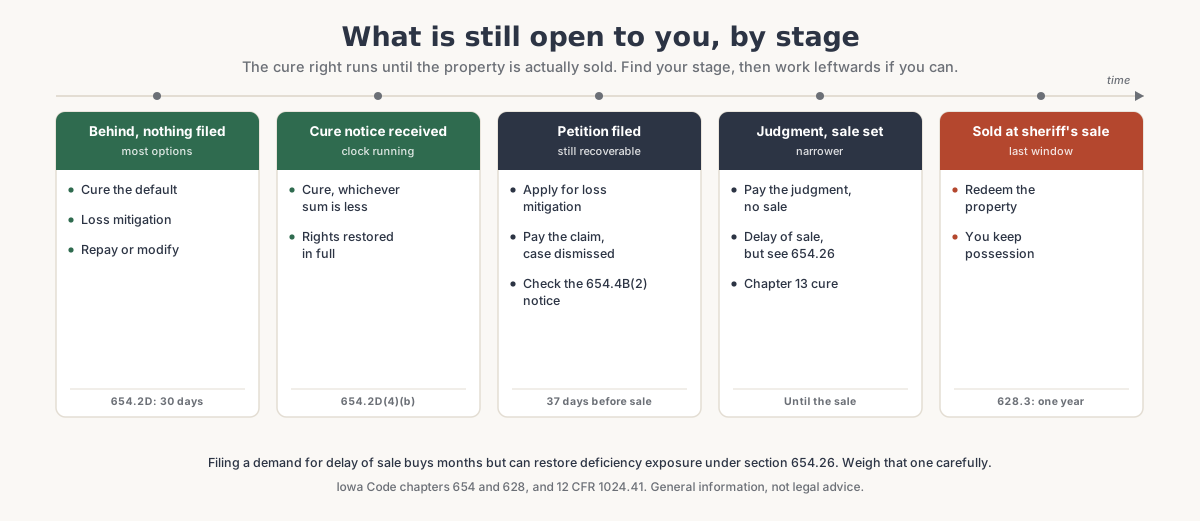
The single most important thing on this page: the right to fix a mortgage default does not end when the case is filed. Under federal bankruptcy law it runs until the property is actually sold at the sheriff's sale.
Which options are open depends on the stage you have reached, and the court file tells you which. We set out the sequence, with the statutes, in the Iowa foreclosure process.
Option one: cure the default, within thirty days
Before starting a foreclosure on your home a creditor must send you a notice of right to cure. Under section 654.2D, a creditor who believes in good faith you are in default on a mortgage on your homestead must give that notice, and you have thirty days from the date it is given to cure.
Two details matter. Curing does not merely pause things: section 654.2D(5) says it restores your rights under the obligation and the mortgage. And what you must pay is capped. Under 654.2D(4)(b) you may cure by tendering either all unpaid instalments due at the time of tender, without acceleration, or the amount stated in the notice, whichever is less. The whole balance has not become due, and you need not act as though it has.
The limit: under 654.2D(7) there is no right to cure if the creditor gave you a proper cure notice for an earlier default within the previous 365 days. It is once a year, not once a quarter.
Section 654.2B sets out what the notice must contain, including the exact date by which you must pay. But a defective notice is not a defence unless you prove you were substantially prejudiced by the failure. A typo does not win the case.
Option two: loss mitigation, and the deadline that actually bites
This is the option most Iowa pages skip, and the one with real teeth, because it is federal and binds your servicer whatever Iowa law says. Your servicer cannot make the first foreclosure filing until you are more than 120 days delinquent, under 12 CFR 1024.41(f). What follows is less well known.
Under 12 CFR 1024.41(g), if you submit a complete loss mitigation application more than 37 days before a foreclosure sale, the servicer shall not move for foreclosure judgment or order of sale, and shall not conduct a sale, until one of three things happens: it tells you that you are eligible for nothing and your appeal rights are exhausted, you reject everything offered, or you fail to perform on an option you agreed.
That is the practical answer to "can I stop the sale". A complete application, filed in time, stops the machinery by federal rule.
The timing rules that go with it:
- 45 days or more before a sale: the servicer must promptly review whether your application is complete and tell you what is missing, under 1024.41(c).
- More than 37 days before: it has 30 days to evaluate you for all available options and write saying which it will offer.
- 90 days or more before: you also get a right of appeal against a loan modification denial, under 1024.41(h).
The word doing the work is complete. An application missing documents does not start these clocks, and the rule only requires the servicer to use reasonable diligence in chasing what is missing. Send what they ask for in writing, and keep proof of the date.
Two limits. A small servicer is exempt from most of this, though under 1024.41(j) it still cannot foreclose while you perform on an agreed option. And under 1024.41(i) a servicer generally need only comply once per borrower, so a second application may not restart the protection.
This produces a reinstatement, a repayment plan spreading arrears over months, a forbearance pausing payments, or a modification changing the loan. Which you are offered depends on your investor and income, not on Iowa law.
Option three: pay the claim or the judgment
The simplest route, and it stays open late. Section 654.21 says that at any time before judgment you may pay the plaintiff the amount claimed in the petition, and the foreclosure action shall be dismissed. At any time after judgment and before the sale you may pay the judgment, and it is satisfied of record and the sale shall not be held.
No lender discretion, no negotiation. It is expensive, because by then it is the accelerated balance plus costs, not the missed payments, but it is certain. It is why a relative willing to lend, or a refinance closing in time, genuinely ends a foreclosure.
Option four: the delay of sale, and its price
The same section gives a lever on timing. Before judgment you may file a demand for delay of sale. On a one or two family dwelling that is your residence, the sale is then held six months after judgment, or three months if the petition waived a deficiency judgment.
There is a real cost to pulling it. A lender can normally pursue you for any shortfall under section 654.6. But under section 654.26, where the lender elected foreclosure without redemption, did not waive a deficiency, the property is your one or two family residence, and you do not file the demand, it is not entitled to a deficiency judgment. File the demand and that protection goes.
So the choice is months in the house against personal liability for the shortfall. Which way it falls depends on how far underwater you are, and it is worth a lawyer's half hour. Section 654.20 requires the petition to state all this on its first page in capital letters.
Option five: the notice most people never check
Under section 654.4B(2), before filing on a one or two family dwelling that is the owner's residence, the creditor must inform the owner that counselling and mediation are available, on a form the attorney general prescribes, posted with the notice of acceleration and served with the petition.
The part that is a remedy rather than a formality: if the court finds the notice was not served as required and that you want counselling or mediation, it shall grant a delay of the sheriff's sale, or of the recording of the sheriff's deed where the sale has happened and the lender was the winning bidder. Up to sixty days.
Two conditions. If the affidavit of service shows the notice was served, there is a rebuttable presumption it was. And your objection is barred unless you apply and the court grants it before the sale or the recording, so check the file early. Section 654.4B(1) also requires a fourteen day demand for the accelerated balance before foreclosing.
Option six: bankruptcy, which is a real answer and a serious one
Filing a bankruptcy petition operates as an automatic stay of any action against you, under 11 USC 362(a), including a scheduled sheriff's sale. It is the only option here that stops a sale without the lender's agreement and without paying the balance.
Chapter 13 is the one that saves houses. Ordinarily a plan cannot modify a claim secured only by your principal residence, under 11 USC 1322(b)(2). But 1322(b)(5) lets a plan provide for curing the default within a reasonable time while maintaining ongoing payments: you spread the arrears over the plan and keep paying the current mortgage.
The deadline is the sentence that matters most on this page. Under 11 USC 1322(c)(1), a default on your principal residence may be cured until the residence is sold at a foreclosure sale. Not until judgment. Until the sale is actually held.
Two traps if you have filed before. Under 362(c)(3), if a case of yours was dismissed within the preceding year, the stay terminates on the 30th day after filing unless the court extends it. Under 362(c)(4), if two or more were dismissed in the previous year, the stay does not take effect at all unless you ask the court to impose it.
Bankruptcy has costs and consequences well beyond the house. Talk to a bankruptcy lawyer, not to us.
Option seven: hand it back, but only on the right terms
If the house is worth less than the debt and you have decided to let it go, there is a statutory deed in lieu that protects you.
Under section 654.18, on mutual written agreement you convey the property to the mortgagee, and it shall accept the conveyance and waive any rights to a deficiency or other claim against you arising from the mortgage. Junior lienholders get thirty days to redeem, and you receive a "Disclosure and Notice of Cancellation" form when you sign.
The waiver is the entire point. A private deed in lieu without one can leave you liable for the shortfall anyway.
Where selling fits, and where it does not
Here we are the interested party, so weigh it accordingly.
Selling only helps if you have equity. If the house is worth meaningfully more than the payoff plus costs, a sale turns that equity into money instead of letting fees and a sheriff's sale consume it. With no equity, selling to anyone, us included, does nothing a short sale or section 654.18 would not do better, and which of those hurts less turns on the shortfall rather than the credit score.
Whether you have equity mostly comes down to how long you have owned. We looked at the Polk County assessor's file for Des Moines residential parcels with a readable deed date, 70,169 of them. Assessed value barely moves with tenure. What changes is the mortgage behind it.
| When you bought | Share of Des Moines owners | Average assessment |
|---|---|---|
| 2015 or earlier | 36.3% | $232,923 |
| 2016 to 2020 | 22.7% | $231,553 |
| 2021 to 2023 | 20.8% | $230,015 |
| 2024 or later | 20.2% | $229,603 |
41% of Des Moines owners bought within the last five years. If that is you, arrears plus fees plus selling costs may be close to everything you have in the house, and a sale will not rescue you. Fight for the loan, or use 654.18.
If you bought before 2016, you are in the group most likely to hold real equity, and protecting it is the goal. That usually means listing, using the cure period, delay of sale or redemption as the time to do it. Start with what your house is worth.
An illustrative example, not a quote. Say the payoff is $168,000, reinstating costs $13,000 in arrears and fees, and the house would fetch $205,000 listed. Listed, less 5.5% commission and about $2,500 of closing costs, you clear roughly $23,225. A cash sale at $178,000 clears $10,000. The gap is about $13,225, close to the cost of simply curing the default.
The numbers are invented. The point is that the reinstatement figure and the cash discount are often the same order of magnitude. Work out both before assuming a sale is the way out.
A cash sale wins on speed and certainty when the sale date is close and a listing cannot close in time, or when the house will not finance for a retail buyer. If that is you, how we buy sets out the process. Check any buyer against the red flags first, including those we would fail.
Free help, which you should use before you call us
Iowa Legal Aid publishes foreclosure self help materials and screens homeowners for free representation. The Iowa Finance Authority runs a mortgage help programme for homeowners in default. HUD approves housing counselling agencies across Iowa, and their advice is free. The attorney general's office prescribes the counselling and mediation form your lender must send you.
None of them will buy your house, which is why their advice is worth more than ours on whether to keep it.
Frequently asked questions
Can I stop the sale the day before it happens? Sometimes. Paying the judgment stops it under section 654.21, and a bankruptcy filing stays it under 11 USC 362(a). The federal protection needed your complete application more than 37 days before the sale, so that one has gone.
Does Iowa have foreclosure mediation? Your lender must tell you counselling and mediation are available under section 654.4B(2), and failing to serve that notice can buy up to sixty days. Mandatory mediation before foreclosure applies to agricultural property under chapter 654A, not to houses.
How long do I have after the sheriff's sale? Usually one year to redeem under section 628.3, the first six months exclusive to you, and you keep possession meanwhile. It can be six or three months where the mortgage contained an agreed reduction and the lender waived a deficiency, under section 628.26, and there is none at all if the lender elected foreclosure without redemption under section 654.20.
Can I sell during a foreclosure? Yes, until the sale is held. The payoff has to be satisfied at closing, which is why equity decides whether it is possible. A deficiency waiver, incidentally, stops the lender pursuing you personally for a shortfall but does not clear second mortgages or judgment liens.
What to do this week
- Find the papers and work out which stage you are at.
- Check the court file for whether the 654.4B(2) counselling notice was served.
- Call a HUD approved counsellor or Iowa Legal Aid. It costs nothing.
- Ask your servicer, in writing, for a loss mitigation application, and count the days to any scheduled sale.
- Only then decide whether to keep or sell. Our common questions cover a cash sale if it comes to that.
If a sale is genuinely the right answer, we will make an offer and tell you plainly if listing would net you more. For most people on this page, it would.
Last verified 2 September 2026 against 654.2B, 654.2D, 654.4B, 654.6, 654.18, 654.20, 654.21, 654.26, 654A.6, 628.3 and 628.26 of the Iowa Code 2026, 12 CFR 1024.41, 11 USC 362 and 11 USC 1322. Ownership figures are from the Polk County assessor's parcel file, which publishes assessed values rather than sale prices. This is general information, not legal or tax advice. Foreclosure timelines turn on the documents in your own case, so speak to an Iowa lawyer or a HUD approved counsellor before deciding.
Wondering what your house is worth?
Polk County publishes an assessed value for every property in Des Moines. Type your address and see yours on screen. No sign-up, and nothing to give us.
Look up my house value