What a Cash Offer Really Nets You vs Listing
A cash offer is a smaller number that keeps more of itself. On a $200,000 Des Moines house the gap is about $18,510, and almost all of it is one line: the commission.
Selling an Inherited House in Iowa: Probate, Taxes and Your Options
A cash offer is a smaller number that keeps more of itself. A listing is a bigger number that gets whittled down. Which one leaves you with more money depends on how much whittling happens, and that is arithmetic, not opinion.
So here is the arithmetic, line by line, on a $200,000 Des Moines house. We buy houses for cash in this metro, so we are one of the two columns below, and the honest answer is that our column loses on price most of the time. What it wins on is everything that is not price.
The answer, up front
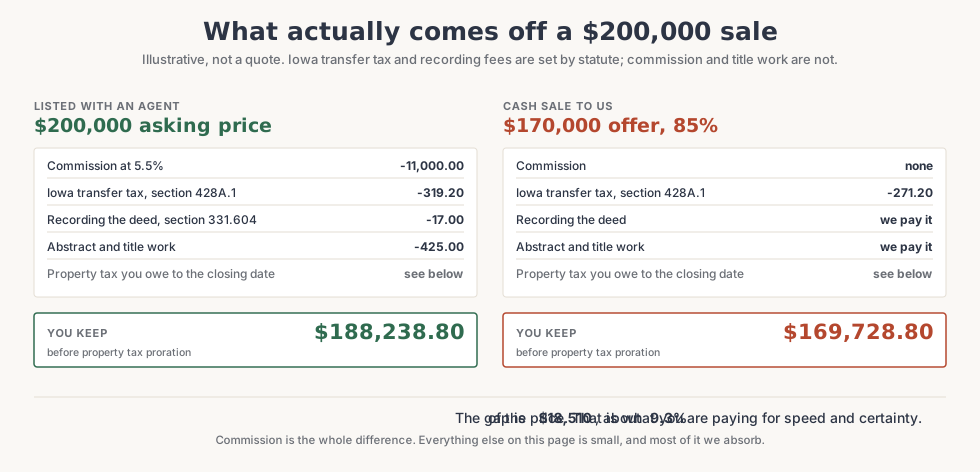
On a $200,000 sale, the gap between listing and selling to us is around $18,510, or about 9.3% of the price. Almost all of that gap is one line: the commission.
Everything else that comes off a sale in Iowa is small. The transfer tax on that sale is $319.20. Recording the deed costs about $17. Those are set by statute and you can check them, which is why we lead with them: the numbers a seller cannot verify are the ones worth distrusting.
The line items, and who sets them
Four things come off a normal Iowa sale, plus a property tax adjustment that deserves its own section. Two of the four are fixed by law. Two are negotiable, and the negotiable ones are the big ones.
| What | On a $200,000 sale | Who sets it |
|---|---|---|
| Commission | About $11,000 at 5.5% | Your listing agreement |
| Transfer tax | $319.20 | Iowa Code |
| Recording the deed | About $17 | Iowa Code |
| Abstract and title work | Several hundred | The market |
| Property tax proration | Depends on your closing date | Iowa Code, see below |
The transfer tax. Under Iowa Code section 428A.1, the tax is eighty cents for each $500, or fraction of $500, of the price above the first $500. Where there is no consideration, there is no tax. It is paid to the county recorder and the amount appears on the face of the document, under section 428A.5.
| Sale price | Transfer tax |
|---|---|
| $150,000 | $239.20 |
| $170,000 | $271.20 |
| $200,000 | $319.20 |
| $250,000 | $399.20 |
Recording. Under section 331.604, the recorder collects five dollars per page, plus one dollar per transaction for records management, plus one dollar per transaction for the county land record information system. A three page deed therefore costs $17 to record. This is the smallest number in your closing and the one people worry about most.
Commission and title work are not set by statute at all. Nobody in Iowa is required to charge 5.5%, and nobody is required to accept it. The 5.5% above is an assumption, and it is the single largest deduction on the page, which makes it the one worth arguing about.
The property tax adjustment nobody explains
This is the line that surprises sellers, and it is a matter of timing rather than money.
Iowa property taxes are paid in arrears. Under section 445.36, you pay one half before September 1 following the levy and the other half before the following March 1, and the section opens by stating plainly that the taxes becoming delinquent during a fiscal year are for the previous fiscal year. So at any closing, some property tax has been earned by the county and not yet billed to anybody.
At closing, that unbilled amount is charged to you, because you owned the house while it accrued. It is not a fee and nobody is profiting from it. It is your share of a bill that arrives later.
Two things make this bigger than sellers expect. First, the further you are into the fiscal year, which starts on 1 July, the more of it you owe. Second, the taxable value the bill is based on is not the same as your assessed value.
Why the taxable value is lower. Iowa applies an assessment limitation, so residential property is taxed on a fraction of its assessed value. Across the 70,579 Des Moines residential parcels in our records above $10,000 of assessed value, that fraction is 0.445, on every single one. The median assessed value is $196,600 and the median taxable value is $87,555.
Do not read 44.5% as a permanent rule. Under section 441.21, that percentage is recalculated every year by the Department of Revenue, and the same section caps annual growth in residential assessed value at three per cent for assessment years from 2013 onwards. It is this year's number, not a law of nature.
We have deliberately not printed a dollar figure for the proration. Getting there needs the consolidated levy rate for your exact taxing district, which combines city, county and school levies, and we could not verify the current rate against a primary source we can link. Ask your closer for the figure on your own parcel and your own closing date. Anyone quoting you a confident statewide number is guessing.
One warning. If you are already behind, section 445.39 charges interest of one and one half per cent per month on delinquent taxes, with each fraction of a month counted as a whole month. That is 18% a year. Delinquent tax is one of the few debts where waiting genuinely costs you more than selling badly.
What the assessed value is and is not
Your assessment is not an offer and it is not a market appraisal.
Under section 428.4, real estate is assessed at its value as of 1 January of the assessment year, and is reassessed every odd numbered year. So the figure sitting on the county website was set on a date that has passed, in a market that has moved since.
That cuts both ways. In a rising market the assessment lags and understates the house. In a falling one it overstates it. Either way it is a starting point for a conversation, not a number to hold anyone to. If you want to see what your own parcel says, what your house is worth starts from the county's own record.
The worked example
Here is the whole thing on one house, with every assumption stated.
Listed. A $200,000 sale. Commission at 5.5% takes $11,000. Transfer tax takes $319.20. Recording a three page deed takes $17. Abstract and title work, say $425. You keep about $188,239, before the property tax adjustment.
Cash to us. An offer of $170,000, which is 85% of that price. No commission. Transfer tax takes $271.20. We pay the customary seller closing costs, so recording and title work come off our side. You keep about $169,729, before the property tax adjustment.
The gap is about $18,510. These are illustrative figures to show the shape of the decision, not a quote. The only real numbers are the ones on your own house.
Read that gap properly. It is not our profit margin, and it is not a fee. It is the difference between two prices, and it is the price of not waiting, not repairing, and not risking a buyer's mortgage falling through.
Two of the four listed deductions are ours to absorb, and we absorb them. That sounds generous until you notice they add up to about $442 on a $200,000 house, against a commission of $11,000. Anyone selling you a cash offer on the strength of "we pay your closing costs" is drawing your attention to the small print and away from the price.
What we do not know about your house
Three things move the real answer more than anything on this page, and none of them is knowable from a median.
Condition. The gap above assumes a house that would list as it stands. If it needs a roof, the listed column has to fund that roof before it can collect the higher price, and the comparison changes completely. That is its own decision, worked through in selling a house that needs repairs.
How long it would sit. Every month on the market costs you tax, insurance and utilities on a house you are not living in. A house that sells in three weeks and a house that sells in four months produce very different net figures from the same price.
Whether the sale completes. A financed buyer can be declined after you have taken the house off the market. The certainty of a cash close has a value that never shows up as a line item, and it is worth more to some sellers than the whole $18,510.
How to check an offer, including ours
The arithmetic above only helps if the number you are given is real. Four questions do most of the work.
Ask what comes off. Get the deductions in writing, itemised, with the closing date named. A verbal net figure is not a net figure.
Ask who pays which costs. "We cover closing costs" should be a list, not a phrase. On a $200,000 sale it is worth about $442, so decide what it is worth before you trade price for it.
Ask for proof of funds, and ask whether the contract can be assigned. A buyer who intends to sell your contract to somebody else is not the buyer. Our page on cash buyer red flags sets out the checks, and how it works sets out our own process without the gloss.
Get more than one offer. Including ours, and including a listing appraisal. Two numbers turn an argument into a comparison.
We will not repeat the industry's standard "70% of after repair value" formula here, or a national average discount, because we cannot verify either and neither can the sites printing them. What we can show you is the statutory side of the ledger, which is the part nobody can fudge.
So which one
If your house is in reasonable condition, you can wait sixty to ninety days, and nothing outside your control is setting the date, list it. You will keep more. On these figures you would keep about $18,510 more, and that is not a close call.
Sell to a cash buyer when the delay itself is the expensive thing: a repair bill you cannot fund, a tax delinquency compounding at 18% a year, a closing date fixed by a job or a court, or a house you simply cannot carry any longer. The whole set of routes, including the middle ones, is laid out in how to sell your house fast.
We would rather you worked this out on paper and told us no than accepted an offer you had not checked. The reader who reads this page and decides to list is not a lost customer. They are somebody who will not spend the next two years wondering.
Frequently asked questions
Do I pay closing costs on a cash sale? With us, no: we pay the customary seller closing costs. Recognise how small that is. On a $200,000 house it is about $442 of a roughly $18,510 gap, so never let it decide the sale.
Does a cash offer skip the transfer tax? No. Section 428A.1 applies to the deed, not to how the buyer funded it. It is charged on the price, so a lower price means a slightly lower tax.
Why is the offer less than my assessment? Different things measured on different dates. Your assessment was set as of 1 January under section 428.4, and it is not a market appraisal.
Will I owe property tax I have not been billed for? Almost certainly yes, for the part of the fiscal year you owned the house. Iowa bills in arrears under section 445.36, so your closer will charge your share at closing.
Is a cash offer worth it if I have equity and time? Usually not. That is the same answer we give on the phone.
Can I negotiate a cash offer? Yes, and the leverage is in the repair estimate rather than the price, because the repair number is the buyer's opinion and the resale value is a matter of evidence. Bring evidence.
The short version
Commission is the whole difference. On a $200,000 house it is about $11,000 of a roughly $18,510 gap, while the statutory costs are $319.20 of transfer tax and about $17 of recording. Expect a property tax adjustment for the part of the fiscal year you owned the house, and ask your closer for the figure rather than trusting a national estimate. If you can wait, list it and keep the difference. If you cannot, get the deductions in writing from everyone bidding, including us.
Last verified 8 September 2026 against Iowa Code section 428.4, 331.604, 428A.1, 428A.5, 441.21, 445.36 and 445.39. Parcel figures are from the Polk County assessor's records and lag the market. Commission, abstract and title figures are illustrative assumptions, not quotes. This is general information, not legal or tax advice.
Wondering what your house is worth?
Polk County publishes an assessed value for every property in Des Moines. Type your address and see yours on screen. No sign-up, and nothing to give us.
Look up my house valueMore on inherited property

The Iowa Small Estate Affidavit Will Not Transfer a House. Here Is What Does
Iowa's small estate affidavit covers up to $100,000 of personal property as of July 2026, but it cannot transfer real estate at all. If the estate includes a house, the route you want is chapter 635 small estate administration, and its ceiling is $200,000.
How Long Does Probate Take in Iowa? Six Months Is the Floor
Iowa probate runs six to twelve months, and the reason for the floor is a four month creditor claim window set by statute. But you do not have to wait for the estate to close to sell the house, and most families should not.