How We Buy Ugly Houses Actually Works
The offer is real and so is the discount, but the word ugly is doing almost no work. Polk County's own assessments show why, and in Iowa nobody buying your house this way needs a licence.
Selling an Inherited House in Iowa: Probate, Taxes and Your Options
You have seen the postcard. Addressed to "the owner", your street name spelled slightly wrong. We buy ugly houses. Any condition. Cash. Close in seven days.
We are a cash buyer in Des Moines, so this comes from the same side of the table as the people sending those postcards. Here is the honest version.
The offer is real, the discount is real, and the word "ugly" is doing almost no work. The pitch says your house is worth less because it is in bad shape. In the price band where these offers land, condition is only part of it. The rest is which side of Des Moines you are standing on, and that was true before anything broke. Polk County's own assessments show it, and it changes what you should ask for.
One thing matters more still: in Iowa, nobody buying your house this way needs a licence. Not the person at your kitchen table, not the company on the postcard. That is legal, not a scandal, and the checks are yours to run.
What "we buy ugly houses" actually means
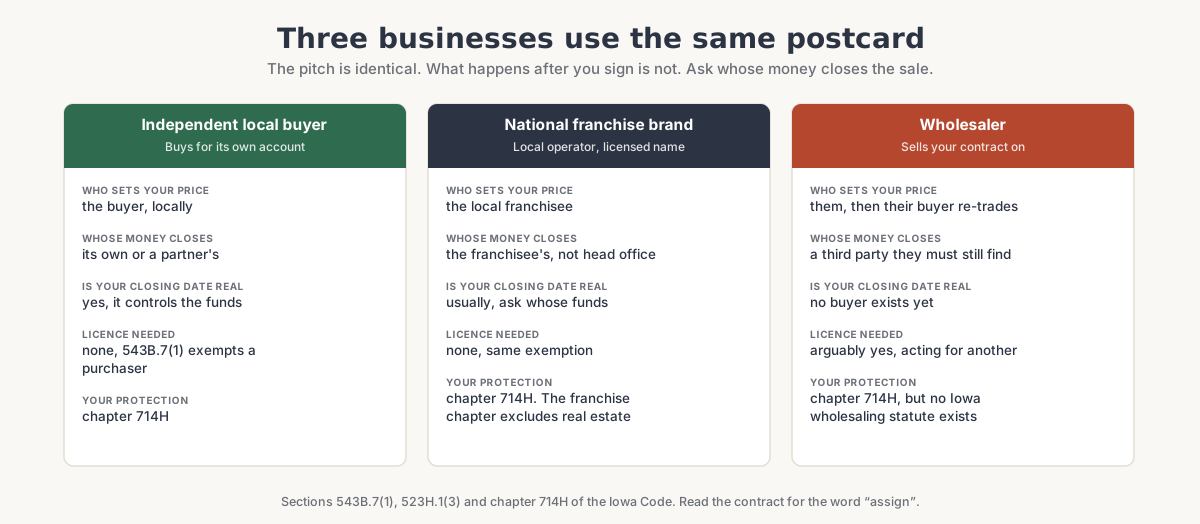
Three businesses use that phrase, and they behave differently once you sign.
A national franchise brand. A marketing name licensed to a local operator who pays for it. The van, the mascot and the postcard come from head office, but the person deciding your price is local and so is their money.
An independent local buyer, buying for their own account. That is us.
A wholesaler. Someone who signs a contract with you and sells it on for a fee. They are not buying your house. They are buying the right to buy it, then finding somebody who will. We have written up the red flags that show which one you are dealing with, because that distinction decides whether your closing date is real.
The postcard cannot tell you which you have. The county recorder can, and we come back to that.
Nobody needs a licence to buy your house in Iowa
Start here, because most people assume the opposite.
Iowa Code section 543B.1 makes it illegal to act as a real estate broker without a licence, and section 543B.6 sets out what counts. The phrase carrying the weight is "for another": a broker acts for another person's account in exchange for a fee or commission. Section 543B.7(1) then excludes anyone acting "as owner ... or prospective purchaser" buying or selling property "owned, rented, leased, or to be acquired by such person."
A cash buyer buying for its own account is a prospective purchaser, so it sits outside the chapter. No licence, no state complaint process of the kind an agent faces. When you list with an agent, a regulator stands behind the transaction. When you sell to a cash buyer, only your contract and the general law do.
The wholesaler sits in the uncomfortable middle. Taking a fee to place a house with a buyer, rather than buying it, is closer to acting "for another," which is the argument that the exemption does not reach them. Iowa has not passed a wholesaling statute, and we checked the 2025 session for one. So there is no Iowa disclosure form, no registration and no cooling-off period. Anyone saying Iowa regulates wholesalers is guessing.
The law that does apply
Consumer fraud. Section 714.16(2)(a) makes it an unlawful practice to use deception, a false promise, a misrepresentation or the concealment of a material fact in connection with the sale of "merchandise," and defines merchandise to include real estate. That is the Attorney General's power.
Your own right to sue. Chapter 714H gives you a private action. Section 714H.5 is worth reading twice: prove an ascertainable loss and the court awards actual damages, and it shall award your costs and your lawyer's reasonable fees. Where the conduct was a willful and wanton disregard of your rights, up to three times actual damages is available. You have two years from the last event or from discovering the violation, whichever is later.
Fee-shifting is the practical point. A $9,000 loss is not worth a lawsuit you fund yourself. It is a different conversation when the statute puts your legal fees on the other side.
Two limits. Section 714H.2 defines a consumer as a natural person, so a house held in an LLC is outside the private action, and section 714H.5(7) gives a defence for an unintentional bona fide error made despite reasonable procedures.
If your house is in or near foreclosure, chapters 714E and 714F apply on top of all this, and they are strict. The Iowa foreclosure process sets out the timeline those rules attach to.
How the offer is actually built
Every cash buyer runs the same arithmetic, whatever the branding: resale value, minus the work, minus the cost of holding and reselling, minus profit. What is left is your offer. On the seller's side of the table, the offer arithmetic works the other way: what comes off a listed sale, and which of those lines the statute actually sets.
You will read that the industry pays "70% of after-repair value" or "50 to 70% of market value." We will not repeat those figures, because we cannot verify them and neither can the sites printing them. They are trade folklore, restated until it looks like data.
Of those four inputs, two are negotiable: resale value is a matter of evidence, so bring evidence, and the repair estimate is the buyer's opinion, so challenge it. The leverage is in the repair number, which is exactly where the "ugly" framing works against you. Once the conversation is about how bad the house is, every extra defect is a reason to cut. The counter-move is to make it about the land.
What Polk County's numbers actually show
Here is where the pitch and the data part company.
We hold the Polk County assessor's parcel file: 183,474 parcels, of which 69,503 are Des Moines residential parcels assessed above $10,000. The assessor values land and building separately, so we can ask what the cheap end of the city is made of.
First, cheap houses are concentrated, not spread evenly.
| Postcode | Residential parcels | Under $100,000 | Share |
|---|---|---|---|
| 50314 | 2,665 | 1,018 | 38.2% |
| 50309 | 1,491 | 440 | 29.5% |
| 50316 | 4,846 | 791 | 16.3% |
| 50317 | 13,657 | 1,615 | 11.8% |
| 50315 | 11,909 | 809 | 6.8% |
| 50310 | 10,868 | 258 | 2.4% |
Citywide, 6,391 of 69,503 houses are assessed under $100,000, which is 9.2%. In 50314 it is 38.2% and in 50310 it is 2.4%, so a house is about sixteen times more likely to sit in that bottom band in one than the other.
Houses in 50310 are not sixteen times better maintained. Both areas have the same ageing timber-framed housing, the same roofs at the end of their life, the same 1950s wiring. What differs is the ground.
Second, the number nobody quotes at your kitchen table: in the sub-$100,000 band, the average Des Moines house carries $21,351 of land value against $55,222 of building. Roughly 28% of the total is ground no repair can improve and no defect can damage.
Read that as a seller. If the buyer's whole story is that your house is ugly, they are explaining a discount on the 72% while staying quiet about the 28%. The land is worth the same whether the porch sags or not. When somebody knocks the price down for a roof, ask what that deduction applies to.
Be clear on the limits. These are assessments, not sale prices: the county publishes assessed values and deed dates, not sale amounts, and assessments lag the market. They remain the only figures covering every house in the city consistently, which is why we use them and why we tell you what they are.
What a fair offer looks like
The unwelcome part first, because it is the trade.
A cash sale nets you less than a listed sale in most cases. If your house is in decent condition, in a postcode where buyers compete, and you can wait sixty to ninety days, listing with an agent will almost certainly put more money in your pocket than we will. Commission is real money, and still usually smaller than the discount a cash buyer needs.
The discount buys certainty and speed: no showings, no financing contingency, no repair negotiation, no buyer's survey killing the deal in week six. Worth something to some people, nothing to somebody who simply wants the most money and has time.
An illustrative example, not a quote. Say a house would fetch $200,000 listed after $15,000 of work. At 5.5% commission plus around $2,500 of seller closing costs, you clear roughly $171,500 once you have paid for the repairs, in maybe ninety days if nothing goes wrong. A cash offer on the same house arrives well below that, and lands in two to three weeks with no repairs and no showings.
The gap is what speed costs. If it is smaller than the value of three months and the risk of a failed sale, take the cash. If it is larger, list it. Those numbers are invented to show the shape of the decision. The only real figures are the ones on your own house.
You can size up the resale side before talking to anybody, using our valuation page and any listing site.
Where we would fail your own checks
We publish this on every page of this kind, because a buyer who only lists other people's weaknesses is selling you something.
- We will not be the highest number you can get. If your house is straightforward and you can wait, list it.
- We are not licensed or regulated as agents, exactly as the franchise is not.
- We are small. A national brand has more capital, so ask us for proof of funds and check it, the same as anyone.
- Our first number is a business decision, not an appraisal. Challenge it.
Six checks, and they take one afternoon
None of these require a lawyer.
- Find out who owns the company. If the business trades under a name that is not somebody's surname and is not an Iowa corporation or LLC, section 547.1 requires a verified statement filed with the county recorder naming every person with an interest in it. Registered entities file with the Secretary of State instead, on a searchable register, and an out-of-state company must register before doing business here under section 490.1502 for corporations or section 489.902 for LLCs. A buyer you cannot name is a buyer you cannot check.
- Look up what they have actually bought. Section 558.49 requires the recorder to index every deed by grantor and grantee, so you can search the buyer's name and see what they have closed on. Section 558.11 makes that record constructive notice to everyone, and your right to see it comes from section 22.2. A company "buying houses in Des Moines for fifteen years" with two deeds to its name is telling you something.
- Ask directly: are you buying this house, or assigning the contract? Then read the contract for "assign" and "and/or assigns" after the buyer's name.
- Separate the land from the building. Compare your parcel's land value with its dwelling value, then ask which part the repair deduction hits.
- Ask what happens if their inspection finds something. The answer you want is that the price is the price.
- Ask who holds your deposit. A title company or a lawyer's trust account, not the buyer's own.
If a franchise brand is involved, ask one more: is this the franchisee or head office, and whose money closes the sale? Iowa's franchise chapter will not help you. Section 523H.1(3) expressly excludes from "franchise" any contract establishing a franchise relationship "with respect to the sale of construction equipment, lawn or garden equipment, or real estate," and also excludes contracts by anyone regulated under chapter 543B. Section 523H.2 limits the chapter to franchises operated from premises physically in Iowa. So the protections you might expect behind the brand name are not there. Yours is chapter 714H, the same as with anyone else.
When selling this way is the right call
We turn work down when listing is clearly better, so here is when it is not.
- The house needs work you cannot fund. A roof and furnace before listing is real money you may not have. What repairs do and do not get you back is its own question.
- There is a deadline with a legal shape to it. A foreclosure sale date, a probate deadline, a divorce settlement, a job in another state.
- Several owners disagree, and one clean sale beats months of coordinating showings between siblings.
- The house is occupied by somebody you do not want to evict, or full of possessions you cannot clear.
If none of those describe you, list it. That is not modesty, it is arithmetic.
Questions people actually ask
Is "we buy ugly houses" a scam? No. It is a legitimate way to sell a house and the offers are usually genuine. What to check is not honesty in the abstract but whether the buyer is buying or assigning, and whether the price can move after you sign.
Do I have to accept the first number? No. It is an opening position. Bring evidence on resale value, challenge the repair estimate, and ask what the deduction applies to.
Can I cancel after signing? Usually not. Iowa gives you no general cooling-off period on a house sale. If your house is in foreclosure the rules are stronger. Otherwise, once you sign you are in a contract. Read it before, not after.
Does the brand on the postcard mean head office is buying my house? Not necessarily. In a franchise the local operator is usually the buyer and sets the price. Ask whose money closes the sale, and check the contract name against the recorder's index.
Will you pay more than the franchise? Sometimes, sometimes not. Anyone promising to beat a competitor before seeing your house is guessing. Get two or three offers.
What if I just want somebody to explain my options? Fair ask. How our process works is written out in full, and our FAQ covers what people ask most.
The short version
The offer is real. The discount is real. The word "ugly" is doing marketing work, not valuation work, because in the cheapest band of Des Moines housing about 28% of the value sits in land that no repair touches.
Nobody buying your house this way needs an Iowa licence. The chapter that protects you is 714H, it lets you recover your legal fees, and it applies to a franchise and to us equally.
Run the six checks. Get two or three offers. If your house is in reasonable shape and you can wait ninety days, list it and keep the difference. We have set out every route for selling fast, and what each one costs, on its own page.
Last verified 1 September 2026 against section 543B.1, section 543B.6, section 543B.7, section 547.1, section 490.1502, section 489.902, section 523H.1, section 523H.2, section 714.16, section 714H.2, section 714H.3, section 714H.5, section 558.11, section 558.49 and section 22.2. Parcel figures are from the Polk County assessor's published assessment file. This is general information about how these sales work, not legal or tax advice, and it is not a substitute for advice on your own house.
Wondering what your house is worth?
Polk County publishes an assessed value for every property in Des Moines. Type your address and see yours on screen. No sign-up, and nothing to give us.
Look up my house value