Selling a House That Needs Repairs in Des Moines
Start with how much of your assessed value is land, because that decides whether repairs can pay you back. Plus what an as-is clause does not switch off, and the lien a contractor can still put on a house you have already sold.
Selling an Inherited House in Iowa: Probate, Taxes and Your Options
If you are selling a Des Moines house that needs work, the single most useful thing you can do first is find out how much of its value is the house and how much is the ground it stands on. That ratio decides whether repairs are worth doing, and it is public information you can look up in an afternoon.
Here is the honest version of the trade. We buy houses for cash in the Des Moines metro, so read this as a page written by an interested party. A cash sale nets you less than a repaired house sold on the open market. What it buys you is certainty, no repair bill to fund, and a closing date you choose. Whether that is a good deal turns almost entirely on the condition question, which is why this page is about how to answer it rather than about us.
The number nobody tells you to look at
Polk County publishes an assessed value for every parcel, split into land and dwelling. We hold a copy of the county's own residential records for Des Moines, and the pattern in them is stark.
| Assessed value | Houses | Land as a share of the assessment |
|---|---|---|
| Under $100,000 | 5,865 | 44% |
| $100,000 to $150,000 | 12,266 | 22% |
| $150,000 to $200,000 | 17,504 | 20% |
| Over $200,000 | 33,237 | 18% |
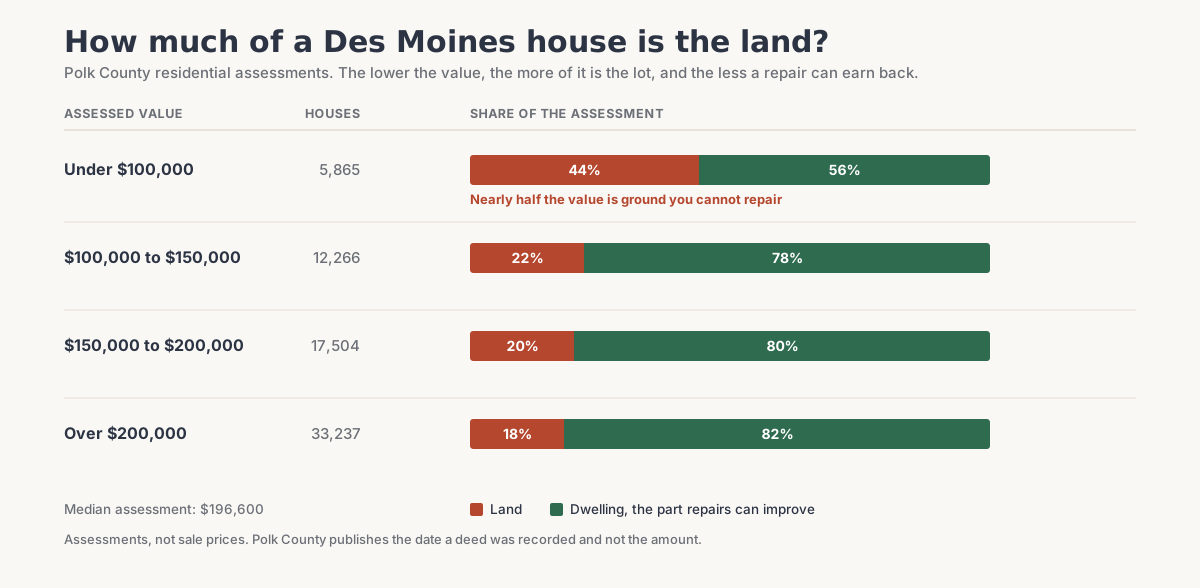
Read the top row again. In the band where most repair decisions get made, nearly half the assessed value is the lot. The median Des Moines residential assessment is $196,600 across about 70,500 houses, so a house down at $90,000 is not a median house having a bad year. It is a house where the structure has stopped carrying the value.
That matters because repair spending only pays you back through the dwelling. If the dwelling is carrying 56% of a $90,000 assessment, you are improving an asset worth about $50,000, and a $20,000 roof and furnace job is 40% of that. In the top band the same $20,000 goes into a dwelling carrying $164,000 or more, and the arithmetic is completely different.
Look yours up before you decide anything. Our what your house is worth today page reads the same county records. Neither that nor the county is a sale price, because Polk County publishes the date a deed was recorded and not the amount.
What "as-is" does not do
Selling as-is says who fixes things. It does not say what you can leave out.
Iowa requires a written disclosure statement about the property's condition, delivered before you accept a written offer, under section 558A.2. Section 558A.4 sets out what goes in it: the condition and important characteristics of the property, significant defects in structural integrity, and, since 1 January 2026, the presence of lead service lines. The commission's rules add plumbing, heating and electrical systems and the presence of pests. Nothing in the chapter switches off because the contract says as-is.
Three things follow that are worth knowing.
Approximation is allowed, guessing is not. Section 558A.3 says that if you do not know something and have made a reasonable effort to find out, you may give an approximation, provided you label it as one and base it on the best information you have. If the boiler is north of thirty years old, say approximately thirty years, not 1994.
Your liability is for what you knew. Under section 558A.6 you are liable for actual damages, but not for an error or omission unless you had actual knowledge of it or failed to use ordinary care in finding out. This is why sellers of rough houses are usually better off over-disclosing. The damp patch you wrote down is a negotiation. The damp patch you knew about and left blank is a claim.
If it changes, amend it. Section 558A.3 requires the statement to be amended if what you disclosed becomes inaccurate or misleading, and the amendment goes through the same delivery process. If the inspection turns up something you did not know, that is the moment.
There are exemptions, and they catch a lot of people selling houses that need work. Section 558A.1(7) excludes a transfer under a court order, a transfer to a mortgagee by an owner in default, a transfer by a fiduciary administering an estate or trust, a transfer between joint tenants, a transfer to a spouse or close relative, and a transfer by quitclaim deed. The fiduciary exemption has a sting: it does not apply if the fiduciary is a living person who occupied the house at any point in the twelve months before the transfer. There is more in our post on selling an inherited house.
If you are exempt, you can still hand over a filled-in form. On a house with real problems, doing so voluntarily is often the cheapest way to stop a buyer walking in week three.
The delivery deadline that quietly gives a buyer an exit
This one gets missed. Under section 558A.2, if the disclosure statement is not delivered on time, the buyer may withdraw the offer or revoke their acceptance without liability, within three days of personal delivery of the statement, or five days if it came electronically or by post.
Late paperwork hands your buyer a free option on your house. If your plan depends on this sale closing, get the statement out before the offer is accepted, not during the title work.
Repairs can leave a lien on a house you have already sold
If you fix the house first, this is the part of Iowa law worth ten minutes of your attention, because most sellers have never heard of it.
Anyone who furnishes labour or materials to improve, alter or repair a building gets a lien on that building and the land under it, under section 572.2. That includes subcontractors you never met and never hired. The plumber your general contractor brought in has a claim against your house, not just against your contractor.
The mechanism runs through a state website. A lien is perfected by posting a verified statement of account to the mechanics' notice and lien registry under section 572.8. A general contractor who will use subcontractors must post a notice of commencement of work within ten days of starting, under section 572.13A, and subcontractors then post preliminary notices against it. The registry is public and indexed by owner name, address and parcel number, under section 572.34.
Now the deadline. A contractor or subcontractor has two years and ninety days from the last day materials were furnished or labour performed to post the lien, under section 572.9. Beyond ninety days they must also give you written notice, under section 572.10, but the window stays open for over two years.
So a repair you paid for in full in spring can surface as a lien claim well after you have sold and spent the proceeds, if your contractor did not pay his subs.
Two protections, both practical.
Ask for the registry number and check it. The statutory owner notice in section 572.13 must be given in boldface type of at least ten points, and it says plainly that you may have to pay a subcontractor even if you have paid your general contractor in full. A general contractor who fails to give that notice is not entitled to a lien at all. Ask for lien waivers from the contractor and each subcontractor as you pay.
If a stale lien is blocking your sale, force the issue. Under section 572.28 you can serve a written demand on the claimant requiring them to start an action to enforce the lien. If they do not file within thirty days, the lien and all benefits from it are forfeited, and you can post the demand with proof of service to have the cancellation recorded. A challenge can go to small claims court if the amount is within its limits, under section 572.24.
Check the contractor before the work, not after
Any contractor doing business in Iowa must register with the state under section 91C.2, which requires evidence of workers' compensation cover and an employer account number, and requires an out-of-state contractor to file a $25,000 surety bond. The exemption is narrow: someone earning under $2,000 a year from it, or working on their own property. Every registration number and the information behind it is a public record, and section 91C.5 directs the state to make it easy for the public to get at.
Separately, nobody may install or repair plumbing, HVAC, refrigeration, sheet metal or hydronic systems without a licence from the state plumbing and mechanical systems board, under section 105.10. A business doing that work must employ a licensed master actively in charge of it, and a sole trader doing it must be a licensed master themselves.
The do-it-yourself exemption is where sellers of rough houses come unstuck. Section 105.11(3) lets an owner work on their own principal residence, but only where it is an existing dwelling rather than new construction, no larger than a single-family house, and, in the statute's own words, only where the residence qualifies for the homestead tax credit.
An inherited house you never lived in does not qualify. Nor does a rental, nor one you moved out of years ago. If you do not live in the house, you cannot lawfully do your own plumbing or HVAC work on it, however handy you are.
So should you repair it?
The land ratio gives you the frame. These are the questions that settle it.
Can you fund the repairs without borrowing against the outcome? A house that needs work generally will not support a purchase mortgage for a retail buyer, which is why cash buyers exist in this part of the market, and why it is worth understanding how those offers are actually built. Fund repairs on credit and repay from the sale, and you have taken on the price, the timeline and the contractor all at once.
Is the problem cosmetic or systemic? Paint, flooring and clearing the place out change what a buyer feels. A failed sewer line, a foundation issue or knob-and-tube wiring change what a buyer can borrow. Spending on the first while the second is untouched produces a well-presented house that still cannot be financed.
Who is going to manage it? If you live out of state, the honest cost includes flights, or a contractor working unsupervised in an empty house for three months while you pay the tax, insurance and utilities.
How is the house priced relative to the street? Improving a house past what the street supports is the most reliable way to spend $30,000 and recover $12,000. If similar houses near you are assessed close to yours, the ceiling is not far above you.
If you can fund it, the problems are cosmetic, you are nearby and the house sits below its street, list it. You will very likely make more money than we will pay you, and we would rather say so here than waste your afternoon. If the timing is the pressure rather than the money, what speed actually costs is worked through on a median Des Moines house.
A worked example, using illustrative figures rather than a quote. A house assessed at $95,000, with $42,000 of that on the land. The dwelling is carrying about $53,000. It needs a roof, a furnace and a bathroom, quoted at $26,000, roughly ten weeks of work once the trades are booked.
Spend the $26,000 and you own an improved $53,000 dwelling, funded up front, sold three to four months later, with commission and closing costs still to come out of the price, plus ten weeks of tax, insurance and utilities on an empty house.
Sold as-is today there is no repair bill, no commission, no carrying cost and no financing that can collapse. The offer will be lower than the repaired number. Whether it is lower by more than $26,000 plus four months of costs is the whole question, and two phone calls answer it: a listing opinion, and a cash number.
Get both. Anyone who tells you the answer before seeing the house is guessing, and anyone quoting a fixed percentage of value has not looked at your land ratio.
What we do and do not do
We buy as-is, which means we take the roof and the furnace and the contents. We pay the customary seller closing costs. We do not charge a commission, and we do not ask you to clear the house out.
We will not always be your best option, and on a sound house in a good street we usually are not. Where we tend to be the right answer is a house with a real repair bill, an owner who cannot fund it, and a deadline that a listing cannot meet. Our how it works page sets out the steps, and the FAQ covers what happens after you accept.
If you want to check us or anyone else before signing, we wrote up the cash buyer red flags worth knowing, including the ones we would fail.
Questions people actually ask
Do I have to disclose problems if I sell as-is? Yes, unless your transfer is one of the exemptions in section 558A.1(7). As-is allocates the cost of fixing things. It does not remove the disclosure duty in section 558A.2.
Will a bank lend on a house that needs major work? Often not on the terms a retail buyer needs. That is the structural reason as-is houses sell to cash buyers rather than to the highest bidder, and it is why a low cash offer and a high listing price are not really the same market.
Can I do the plumbing myself to save money? Only if it is your principal residence and it qualifies for the homestead tax credit, per section 105.11(3). On an inherited house or a rental, no.
A contractor has put a lien on the house. Can I still sell? You will normally have to clear it at closing or escrow for it. If the claim is stale or wrong, the section 572.28 demand is the fast route: they file within thirty days or forfeit the lien.
Is a low offer on a rough house a rip-off? Not by itself. Compare it against the repaired price minus repairs, commission, carrying costs and the risk the work overruns. Sometimes the gap is real and listing wins. Say no when it does. Our cash offer vs listing page itemises that comparison on a $200,000 house.
The short version
Look up your parcel and find out how much of the value is land. In the sub-$100,000 band in Des Moines that is about 44%, which changes the repair sum completely. Get a written disclosure statement out on time, because late delivery gives your buyer a walk-away right. If you repair first, get the registry number, collect lien waivers, and remember a subcontractor has two years and ninety days to come after the house. Then get two numbers, a listing opinion and a cash offer, and pick the one that survives your actual constraints.
Last verified 28 August 2026 against the primary sources linked above: Iowa Code 558A.1, 558A.2, 558A.3, 558A.4, 558A.6, 572.2, 572.8, 572.9, 572.10, 572.13, 572.13A, 572.24, 572.28, 572.34, 91C.2, 91C.5, 105.10 and 105.11. Assessment figures are from Polk County's published parcel records for Des Moines residential property, which are assessments and not sale prices. The worked example uses illustrative figures, not a quote. This is general information about how Iowa law works, not legal or tax advice about your situation, and you should talk to an Iowa attorney about your own facts.
Wondering what your house is worth?
Polk County publishes an assessed value for every property in Des Moines. Type your address and see yours on screen. No sign-up, and nothing to give us.
Look up my house value